
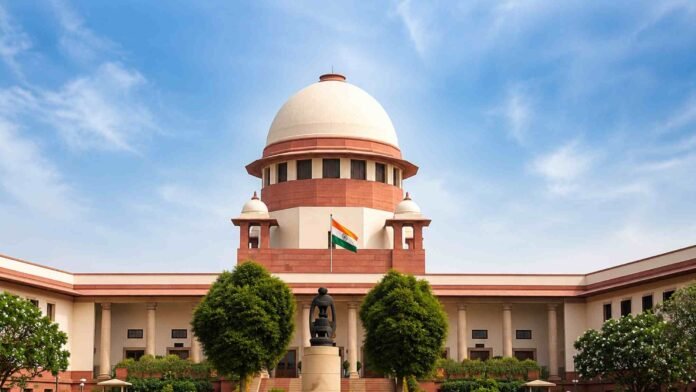
The Supreme Court has ruled that government employees do not possess a vested or enforceable right to promotion merely because vacancies exist.
The bench of Justice Dipankar Datta and Justice Augustine George Masih has observed that an employee only has a limited right to be considered for promotion in accordance with the rules prevailing at the time of consideration and that the Government is free to alter recruitment policy following cadre restructuring, provided such changes are fair and lawful.
The court allowed appeals filed by the State of Odisha and set aside the Orissa High Court’s directions requiring authorities to convene a Departmental Promotion Committee (DPC) for promotion to the post of Assistant Regional Transport Officer (ARTO).
The dispute arose from claims made by Sreepati Ranjan Dash and Aditya Bhanjan Sahoo, who had initially joined government service as Junior Assistants and later became Senior Assistants. Following a restructuring exercise in Odisha’s administrative setup, the post of Senior Assistant was redesignated as Assistant Section Officer (ASO). The respondents argued that they remained eligible for promotion to the post of Assistant Regional Transport Officer under old Executive Instructions that governed appointments before formal recruitment rules came into force.
The controversy intensified after the State Government repeatedly rejected recommendations to hold a DPC for filling vacant ARTO posts. Authorities maintained that after restructuring of the cadre and creation of the Odisha Transport Service framework, the post of ARTO no longer formed part of the respondents’ promotional hierarchy. Subsequently, the Odisha Transport Service (Method of Recruitment and Conditions of Service) Rules, 2021 were notified under Article 309 of the Constitution. Under these rules, recruitment to ARTO posts was intended to be made through competitive examination rather than promotion.
The Orissa High Court had earlier sided with the employees and directed authorities to convene the DPC and consider their cases under the Executive Instructions. However, the Supreme Court found the High Court’s approach legally unsustainable.
The Court strongly relied upon its earlier judgment in State of H.P. v. Raj Kumar, which had clarified that there is no universal rule requiring vacancies to be filled according to the recruitment rules existing when those vacancies first arose. Instead, candidates are entitled to consideration under the rules that are in force when the process of consideration actually takes place.
The Bench observed that the Government had consciously decided not to fill the vacancies through the old mechanism because of cadre restructuring and implementation of new service rules. According to the Court, such policy decisions cannot ordinarily be interfered with unless shown to be arbitrary or unconstitutional.
The Supreme Court also rejected the argument that actions initiated under the earlier Executive Instructions survived after implementation of the 2021 Rules. It held that merely requesting a DPC meeting could not be considered a completed act protected by the saving clause in the new rules. Since no DPC had actually been constituted and no appointments had been made before the new rules took effect, there was nothing that could be preserved from supersession.
Further, the Court reiterated the settled legal principle that rules framed under Article 309 prevail over executive instructions whenever a conflict arises. Therefore, once statutory service rules came into existence, the earlier executive arrangements automatically yielded to the new framework.
Importantly, the Court distinguished between a “promotion post” and a “selection post”. It held that ARTO was a selection post and not a promotional post. Consequently, employees could not claim appointment as a matter of right merely based on seniority or existence of vacancies. Merit and policy considerations remained decisive factors.
The Supreme Court concluded that the High Court had acted erroneously in compelling the Government to proceed with promotions under a framework that had already been replaced by statutory rules.
Case Details
Case Title: State Of Odisha & Ors. Versus Sreepati Ranjan Dash
Citation: JURISHOUR-1296-SC-2026
Case No.: Civil Appeal No.13121 Of 2025
Date: 18/05/2026
Read More: Supreme Court Upholds Directions to Remove Stray Dogs From Institutional Areas

