
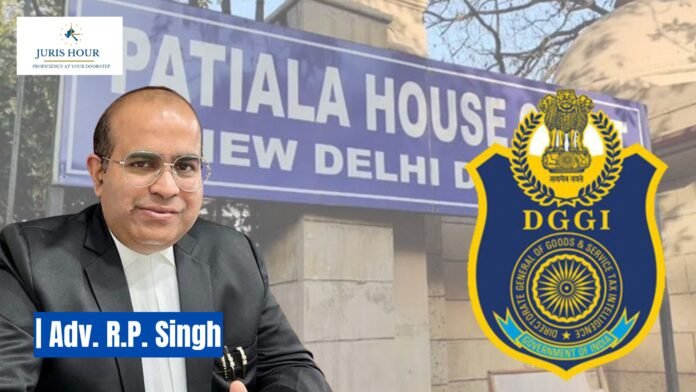
The Patiala House Courts has granted regular bail to aRodion Khakimov, Russian national accused in a Directorate General of GST Intelligence (DGGI) case involving alleged fraudulent availment of Input Tax Credit (ITC) worth more than ₹6.14 crore under the CGST Act, observing that no fruitful purpose would be served by keeping the accused in further custody once investigation was substantially complete and the evidence was primarily documentary and electronic in nature.
According to the DGGI, the accused allegedly directed employees to avail fraudulent ITC in the names of M/s OneClick Money Techplus Pvt. Ltd. (OMTPL) and M/s XLBIT Solutions Pvt. Ltd. through invoices issued by non-existent dummy firms without actual receipt of underlying services. The prosecution alleged that the accused exercised actual control over multiple companies where employees were merely shown as directors on paper.
The department alleged that fraudulent ITC amounting to ₹6,14,55,854 had been availed in violation of Section 132(1)(c) of the CGST Act, 2017. It was further argued by the prosecution that the accused operated around 12 companies through dummy directors and that statements of employees indicated that the actual control of these entities rested with him.
During the hearing, counsel for the accused argued that the offence had effectively become bailable because more than ₹3.34 crore had already been deposited towards the alleged tax liability. It was submitted that ₹2.74 crore along with an additional ₹60 lakh had been deposited by the concerned companies. The defence also contended that the accused had cooperated throughout the investigation, supplied passwords of his laptop and mobile phone, and that his statements under Section 70 of the CGST Act had already been recorded.
The Investigating Officer admitted before the Court that the deposits had indeed been made and also acknowledged that the accused had cooperated during the investigation and had already provided passwords and access to electronic devices. The IO further confirmed that two statements of the accused had already been recorded and that he had remained in custody since 27 March 2026.
While considering the bail plea, the Court relied upon the Delhi High Court judgment in Tarun Jain vs. Directorate General of GST Intelligence (DGGI), where it was observed that although GST offences are economic offences, the maximum punishment prescribed under the CGST Act cannot be ignored while assessing the gravity of the offence. The High Court had held that offences under the GST regime are not so grave that custody becomes indispensable in every case.
The Court noted that the maximum punishment in the present case was imprisonment extending up to five years along with fine. It also took note of the fact that the accused had already spent around 46 days in custody and that more than half of the alleged fraudulent ITC amount had already been deposited.
Importantly, the Court observed that the investigation appeared substantially complete, the evidence was largely documentary and electronic in character, and there was no indication that the accused was likely to tamper with evidence or influence witnesses. The Court further observed that the accused did not appear to be a flight risk despite being a foreign national.
Holding that no useful purpose would be achieved by continued incarceration, the Court granted bail subject to furnishing a personal bond of ₹1 lakh along with one surety of the like amount. The Court imposed several conditions, including that the accused must not leave India without prior permission of the Trial Court, must keep his mobile phone operational at all times, must inform authorities about his residential address, and must not tamper with evidence or commit a similar offence while on bail.
The Court clarified that the observations made in the order were only for the purpose of deciding the bail application and should not be construed as an opinion on the merits of the case.
Case Details
Case Title: DGGI Vs. Rodion Khakimov
Case No.: Bail Matters 982/2026
Date: 12/05/2026
Counsel For Accused: Advocate R P Singh

