
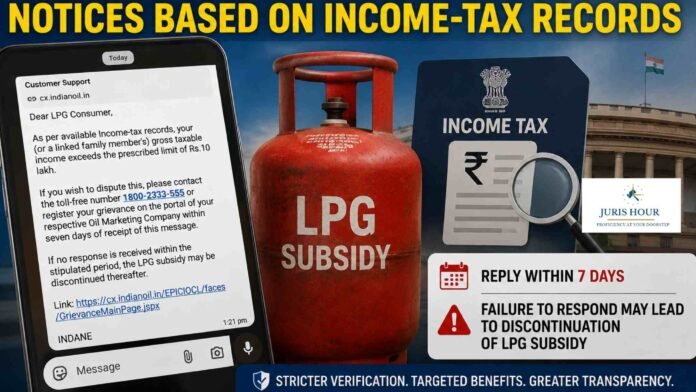
The Central Government has reportedly begun sending text message alerts to LPG consumers regarding their eligibility for domestic cooking gas subsidy, with verification now being linked to Income-Tax records and family income disclosures. The move signals a fresh phase of stricter scrutiny over subsidy beneficiaries amid efforts to streamline welfare expenditure and prevent ineligible households from availing subsidised LPG cylinders.
According to the messages being circulated among consumers, individuals whose gross taxable income — either of the consumer or a linked family member — exceeds ₹10 lakh annually are being asked to respond or update their status within seven days. The communication further warns that failure to comply within the stipulated period may result in discontinuation of LPG subsidy benefits.
The development has triggered widespread discussion among consumers, especially those covered under the domestic LPG subsidy framework operated through Direct Benefit Transfer (DBT) mechanisms. The government has historically maintained that households with annual income exceeding ₹10 lakh are not eligible for LPG subsidy benefits under the PAHAL scheme and related subsidy programs. However, the latest communication suggests that authorities may now be undertaking more active and data-driven verification exercises using Income-Tax databases and linked identification records.
The subsidy framework for domestic LPG cylinders was originally designed to support economically weaker and middle-income households by transferring subsidy amounts directly into consumers’ bank accounts. Over the years, the government has repeatedly encouraged financially well-off consumers to voluntarily surrender subsidy benefits under campaigns such as “Give It Up.” The current verification exercise appears to indicate a transition from voluntary compliance to more rigorous automated scrutiny and enforcement.
Sources familiar with the process indicate that the verification may involve cross-checking PAN-linked tax information, Aadhaar-linked family records, and LPG consumer databases to identify households falling outside prescribed eligibility norms. The reference to “linked family member” in the messages has particularly drawn attention, as it may broaden the scope of income assessment beyond the registered LPG connection holder alone.
Consumers receiving such notices are reportedly being advised to verify their KYC details, income declarations, and linked records through authorised LPG distributors or official portals of oil marketing companies. Failure to respond within the prescribed timeline could potentially lead to suspension or discontinuation of subsidy credits, though consumers would still be able to purchase LPG cylinders at market rates.
The move aligns with the government’s broader push towards targeted delivery of subsidies and reduction of leakage in welfare schemes through digital verification systems and tax-data integration. In recent years, authorities have increasingly relied upon Aadhaar authentication, PAN linkage, DBT architecture, and analytics-based beneficiary screening to identify duplicate, fake, or ineligible beneficiaries across various schemes.
The latest development may also lead to renewed debate regarding privacy concerns, family-income aggregation, and procedural safeguards in automated subsidy verification exercises. Experts note that any adverse action affecting subsidy entitlement would ideally require clear communication, accessible grievance mechanisms, and opportunities for consumers to correct or contest discrepancies in records.
For millions of LPG consumers, the ongoing exercise serves as a reminder that subsidy eligibility is now being monitored more closely through integrated digital compliance systems, with Income-Tax records increasingly playing a central role in welfare verification processes.
Read More: PM Modi Urges Citizens To Save Fuel, Avoid Gold Buying And Foreign Travel Amid Global Crisis

