
The Chennai Bench of the Customs, Excise and Service Tax Appellate Tribunal (CESTAT) has set aside the excise duty demand raised against a manufacturer over the classification of “Farmers Integrated Handbook”, holding that the extended period of limitation under Section 11A of the Central Excise Act cannot be invoked merely because the assessee failed to declare the goods in ER-1 returns, in the absence of suppression with intent to evade payment of duty.
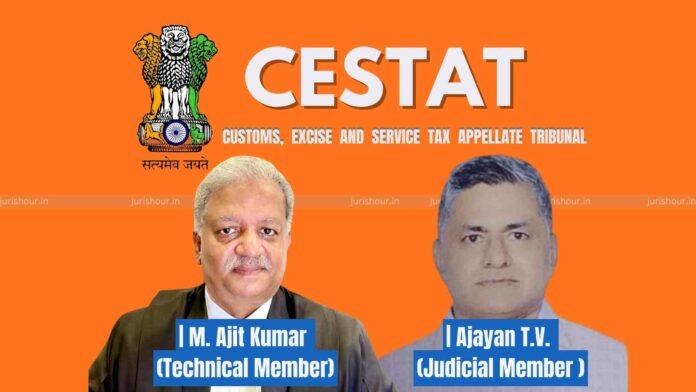
The bench of Ajayan T.V. ( Judicial Member) and M. Ajit Kumar (Technical Member) has observed that suppression of facts must be deliberate and accompanied by an intent to evade duty and mere non-payment or non-disclosure does not automatically justify invocation of the extended limitation period.
The dispute arose after departmental audit officers noticed during an audit conducted in June 2014 that the assessee had cleared “Farmers Integrated Handbook” without payment of excise duty by classifying the product under tariff heading 49109900. The Department alleged that the product was actually classifiable under Chapter Heading 4820 as pre-printed stationery and was therefore excisable.
According to the Department, the handbook consisted of four-folded paper boards containing printed headings and blank columns intended to be periodically filled by agricultural officers with details relating to land cultivation, soil testing, fertilizers, pesticides and benefits provided to farmers under government schemes. The books were issued by the Tamil Nadu Agricultural Department for maintenance over a three-year period.
The Department issued a show cause notice on 29.02.2016 invoking the extended limitation period under Section 11A(4), alleging suppression of facts on the ground that the assessee had not disclosed manufacture and clearance of the handbooks in ER-1 returns.
The assessee contended that the demand was entirely barred by limitation since the audit was conducted in June 2014 and the Department had knowledge of the alleged non-payment at least from 01.07.2014. The assessee had also paid duty under protest in July 2014 and informed the Department accordingly. However, the show cause notice was issued only on 29.02.2016, well beyond the normal limitation period of one year.
The Tribunal extensively examined the legal requirements for invoking the extended limitation period under Section 11A(4) and referred to several Supreme Court judgments including Chemphar Drugs & Liniments, Tamil Nadu Housing Board, Pushpam Pharmaceuticals, Uniworth Textiles and Northern Operating Systems.
While analysing the facts of the case, the Tribunal noted that the assessee had consistently disputed the proposed classification and had expressed a bona fide belief that the goods were correctly classifiable under Chapter 49 and carried NIL rate of duty. The assessee had also relied upon Chapter Note 10 of Chapter 48, which excludes loose sheets or cards cut to size from Heading 4820.
The Bench held that the assessee’s conduct could not be treated as deliberate suppression or conscious withholding of information with intent to evade payment of duty. It therefore concluded that invocation of the extended period was unsustainable.
Importantly, the Tribunal also observed that the departmental audit had already examined the assessee’s records and ER-1 returns in 2014. Relying on precedents including Rajkumar Forge Ltd., Pragathi Concrete Products Ltd. and other cases, the Bench held that once the Department had audited the records, it could not subsequently allege suppression to invoke the extended period of limitation.
The Tribunal ultimately held that the show cause notice issued in February 2016 for the period April-May 2013 was clearly beyond the normal limitation period and therefore time-barred.
After holding the demand barred by limitation, the Tribunal declined to examine the classification issue on merits. Referring to various High Court and Supreme Court decisions, the Bench observed that once proceedings are found time-barred, adjudication on merits would be unnecessary and legally impermissible.
The CESTAT set aside the impugned order along with the consequential demand of interest and penalty and allowed the appeal with consequential reliefs.
Case Details
Case Title: M/s. ICMC Corporation Limited Versus Commissioner of GST & Central Excise
Citation: JURISHOUR-1117-CES-2026(CHE)
Case No.: Excise Appeal No.40364 of 2018
Date: 05.05.2026
Counsel For Appellant: S. Gokarnesan, Advocate
Counsel For Respondent: Sanjay Kakkar, Authorised Representative

