
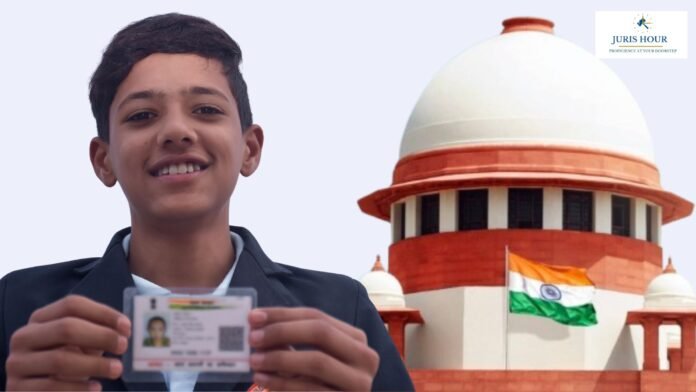
The Supreme Court has disposed of a public interest litigation seeking stringent directions to the Unique Identification Authority of India (UIDAI) to strengthen Aadhaar verification mechanisms and prevent illegal infiltrators from allegedly obtaining Aadhaar and masquerading as Indian citizens. The Court observed that most of the reliefs sought required legislative intervention and amendments in the existing statutory framework, which lay beyond the judicial domain.
The Bench of Chief Justice of India Justice Surya Kant and Justice Joymalya Bagchi has observed that the appropriate course for the petitioner would be to bring the issues raised in the PIL to the notice of State authorities and other stakeholders for appropriate consideration.
The writ petition was filed by advocate and petitioner-in-person Ashwini Kumar Upadhyay under Article 32 of the Constitution.
The petition claimed that UIDAI had issued nearly 144 crore Aadhaar numbers and that around 99% of Indians had already been enrolled. Against this backdrop, the petitioner sought directions to UIDAI to issue fresh Aadhaar only to children and to frame stringent guidelines for adolescents and adults in order to stop infiltrators from obtaining Aadhaar and posing as Indian citizens.
The plea also sought installation of display boards at Common Service Centres and Aadhaar enrolment centres clarifying that Aadhaar is merely proof of identity and not proof of citizenship, address or date of birth. It further sought mandatory undertakings from applicants regarding the correctness of information furnished and awareness of punishment for false statements, false certificates and fake documents.
In the petition, Upadhyay alleged that infiltrators were exploiting weak and easily manipulable verification mechanisms under the Aadhaar Act, 2016 to procure Aadhaar cards and thereafter obtain ration cards, birth certificates, domicile certificates and driving licences. The petition stated that such practices diluted the reliability of the identification framework and enabled unauthorised persons to avail subsidies, benefits and services meant for citizens.
The petitioner argued that although foreigners legally entering India are issued Aadhaar under a separate “Foreigner Enrolled as a Resident” category, infiltrators allegedly apply under the Indian citizen category and obtain regular Aadhaar cards with relative ease. The plea referred to UIDAI Office Memorandum dated August 22, 2023 which distinguished between foreigners and nationals, but alleged that the Aadhaar framework lacked sufficient safeguards to maintain this distinction effectively.
The petition also challenged what it described as the “temporal unreasonableness” of the Aadhaar Act. It claimed that while the legislation was originally enacted for efficient and targeted delivery of subsidies, the present system allegedly allowed illegal immigrants to use Aadhaar as a foundational document to gradually obtain additional identity documents and benefits.
The plea contended that the issue had serious implications for national security, demographic balance and electoral integrity. Referring to Articles 326 and 327 of the Constitution, the petitioner alleged that infiltrators allegedly obtaining identity documents could eventually secure voter identification and participate in elections, thereby affecting the constitutional scheme governing elections and universal adult suffrage.
The petition relied extensively on constitutional provisions including Articles 14, 19, 21, 29, 326, 327 and 355, contending that infiltration amounted to both “external aggression” and “internal disturbance.” It also relied upon the Supreme Court’s judgment in Sarbananda Sonowal v. Union of India (2005) 5 SCC 665, wherein the Court had discussed large-scale illegal migration and its implications for national security and demographic change.
One of the principal prayers in the PIL sought a judicially imposed cap restricting issuance of Aadhaar to citizens only up to the age of six years, after which identity verification would allegedly require more stringent checks through local administrative authorities such as SDMs or Tehsildars. The petitioner claimed that such a mechanism would help curb infiltration because children below six years rarely migrate independently.
The petition further alleged that the existing Aadhaar framework created a “statutory vacuum” by permitting unrestricted enrollment without a robust mechanism to distinguish between legally entered foreign nationals and infiltrators. According to the plea, recommendations of village pradhans and municipal councillors were allegedly being accepted without adequate nationality verification.
However, after hearing the petitioner appearing in person and examining the material placed on record, the Supreme Court observed that the nature of reliefs sought substantially required legislative intervention and policy decisions. The Bench held that such actions ordinarily fall outside the Court’s jurisdiction unless extraordinary circumstances warrant exercise of exceptional constitutional powers.
The Supreme Court disposed of the writ petition and directed that it be treated as a representation before the authorities concerned.
The Court also directed the petitioner to deposit requisite copies of the petition before the Registry within three days so that the same could be forwarded to the respondents for appropriate consideration.
Case Details
Case Title: Ashwini Kumar Upadhyay Versus Union Of India & Ors.
Citation: JURISHOUR-1111-SC-2026
Case No.: Writ Petition(s)(Civil) No(s).473/2026
Date: 04-05-2026

