
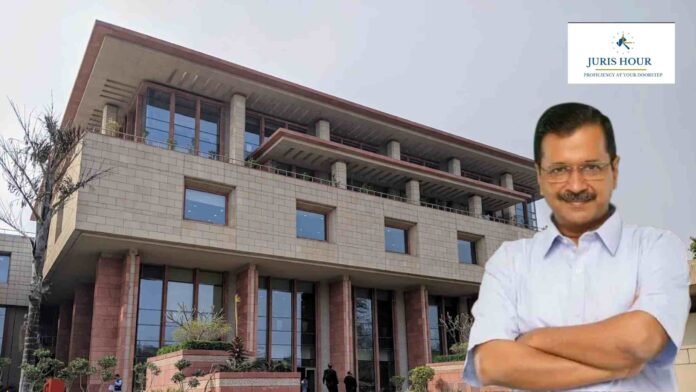
Raising questions around judicial impartiality and conflict of interest, a detailed letter has been placed on record before the Delhi High Court by Arvind Kejriwal expressing his inability, on grounds of conscience, to participate further in proceedings in Criminal Revision Petition No. 134/2026.
The communication, addressed to Justice Swarana Kanta Sharma, follows the dismissal of a recusal application on April 20, 2026. It asserts that despite the court’s order, the apprehensions regarding fairness and impartial adjudication remain unresolved, thereby making continued participation untenable.
Faith in Judiciary, But Doubts in Process
At the outset, Kejriwal underscores deep respect for the judiciary as an institution, emphasizing its historical role as a protector of constitutional values and citizens’ rights. However, he simultaneously raises a broader concern: whether justice in the present matter would not only be done but also be seen to be done—a cornerstone principle of natural justice.
He states that the recusal plea was made in good faith, rooted in genuine apprehension. However, the rejection of that plea, coupled with the language of the order, is said to have reinforced concerns rather than dispelled them. According to the letter, the judicial response appeared to treat the apprehension as a personal affront rather than addressing it as a legal issue, thereby eroding confidence in the fairness of further proceedings.
Allegations of Conflict of Interest
A central issue highlighted is the alleged conflict of interest arising from professional engagements of the presiding judge’s immediate family members. The letter claims that both children of the judge are empanelled as advocates for the Union Government, which is a party to the case.
It is further pointed out that the Solicitor General, appearing for the opposing side, plays a role in assigning cases to panel counsel, including those related to the judge’s family members. The letter refers to RTI-based information suggesting a disproportionately high number of case allocations to one of them, raising concerns about financial and professional proximity.
The financial implications of such assignments are also flagged, noting that each docket carries a daily appearance fee, potentially amounting to substantial earnings over time.
Sequence of Events Raising Apprehension
The letter draws attention to the timeline of judicial appointment and subsequent empanelment of family members in government panels, suggesting that the sequence could deepen public perception of conflict.
It further argues that in politically sensitive matters involving the Union Government, such circumstances may give rise to a reasonable apprehension in the mind of a litigant regarding the likelihood of an unbiased adjudication.
Buy Now: E-Compilation of Supreme Court Judgements – March 2026
Reference to Judicial Ethics and Precedents
To support his stance, Kejriwal invokes instances where judges have voluntarily recused themselves or sought transfers in similar situations to avoid even the appearance of bias. He stresses that such steps historically strengthened public trust in the judiciary rather than diminishing it.
The communication also refers to remarks made by former Supreme Court judge Justice Abhay S. Oka, highlighting concerns about perceived affiliations with organizations having political inclinations, thereby reinforcing that such apprehensions are not unfounded or unprecedented.
Criticism of Recusal Order Language
A significant portion of the letter critiques the tone and content of the order rejecting recusal. It contends that the observations—referring to “accusations” and attempts to “intimidate the court”—mischaracterize a legal plea as a personal attack.
According to the letter, such framing has compounded the apprehension by indicating that the concerns were not addressed on merits but perceived as challenges to judicial authority.
Gandhian Principle of Conscience
Invoking the principle of Satyagraha as articulated by Mahatma Gandhi, Kejriwal explains the decision to withdraw from proceedings as a matter of conscience rather than defiance. He emphasizes that after exhausting institutional remedies, including a formal recusal request, the only remaining course is to step aside while accepting potential legal consequences.
He acknowledges that non-participation may prejudice his own case but asserts that continuing under perceived bias would amount to a compromise of conscience.
Larger Question of Public Confidence
The letter frames the issue beyond an individual case, suggesting that it has now entered the realm of public discourse. It argues that when circumstances create widespread doubt about impartiality, the impact extends to the credibility of the institution itself.
He reiterates that justice must not only be fair but must inspire confidence among citizens. If proceedings appear predetermined due to surrounding circumstances, participation becomes a mere formality devoid of meaningful adjudication.
Limited Scope of Withdrawal
Importantly, the communication clarifies that the decision to not participate is confined to this particular matter and similar situations where such apprehensions arise. It expressly states that this should not be construed as a general refusal to appear before the court in other cases.
Possible Legal Steps Ahead
The letter also reserves the right to challenge the order rejecting recusal before the Supreme Court of India, indicating that further judicial scrutiny of the issue may follow.
Conclusion
Reaffirming faith in the Constitution and the judiciary as an institution, Kejriwal concludes by requesting that the letter be taken on record and that the court proceed as deemed appropriate.
The episode brings into focus the delicate balance between judicial independence and the perception of impartiality—an issue that lies at the heart of public confidence in the justice delivery system.
Read More: Foreign Judgment Passed Without Full Trial Not Enforceable in India: Supreme Court

