
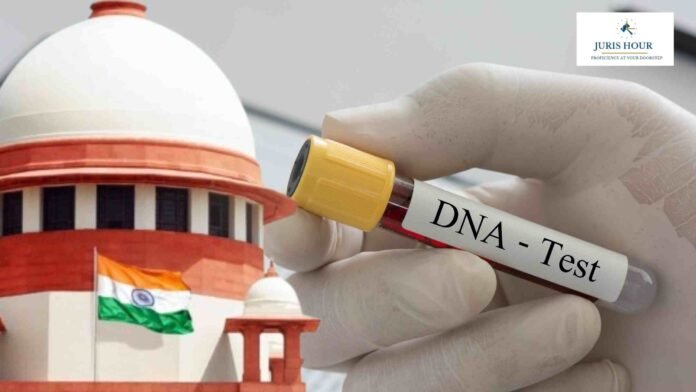
The Supreme Court of India has held that where a DNA test conclusively establishes non-paternity, the legal presumption of legitimacy under Section 112 of the Indian Evidence Act, 1872 cannot override such scientific proof.
The bench of Justice Prashant Kumar Mishra and Justice N.V. Anjaria has dismissed an appeal filed by a mother seeking maintenance for her minor child, affirming the denial of maintenance to the child on the ground that the respondent was not the biological father.
The appellant had alleged that the respondent established a relationship with her on the pretext of marriage and later married her. A child was born shortly thereafter. However, during proceedings, the respondent sought a DNA test to establish paternity. The test report concluded that he was not the biological father of the child.
Relying on this report, the Trial Court denied maintenance to the child. This finding was upheld by the Appellate Court and later by the Delhi High Court. The High Court also examined the scope of Section 112 of the Evidence Act, which provides a conclusive presumption of legitimacy for children born during a valid marriage, but held that such presumption would not apply once a DNA test had conclusively determined otherwise.
Before the Supreme Court, the central issue revolved around the interplay between Section 112 of the Indian Evidence Act, 1872 and modern scientific evidence like DNA testing.
Buy Now: E-Compilation of Supreme Court Judgements – March 2026
The Court undertook an extensive review of precedents, including Goutam Kundu, Nandlal Wasudeo Badwaik, and Aparna Ajinkya Firodia, to trace the evolution of law on paternity determination. It noted that while Section 112 was enacted to protect children from the stigma of illegitimacy, the advancement of scientific methods necessitates a nuanced approach.
Crucially, the Court relied on the principle laid down in Nandlal Wasudeo Badwaik, holding that when a DNA test conducted under court orders is available and has attained finality, it cannot be ignored in favour of a legal presumption.
The Bench clarified that although courts generally exercise caution in directing DNA tests due to privacy concerns and potential social stigma, once such a test is validly conducted and accepted, its evidentiary value prevails.
The Court distinguished the present case from decisions like Aparna Ajinkya Firodia, where emphasis was placed on protecting the legitimacy of the child even in the face of DNA evidence. It noted that those cases primarily dealt with whether a DNA test should be ordered.
In contrast, the present case involved a situation where the DNA test had already been conducted, the appellant had consented to it, and the results were not challenged at any stage.
Thus, the Court held that the case squarely falls within the principle that truth established through scientific evidence must prevail over presumptions.
Upholding the High Court’s decision, the Supreme Court dismissed the appeal, holding that no maintenance could be granted to the child from a person who is not the biological father.
However, taking note of the child’s welfare, the Court issued an important direction to the Department of Women and Child Development, Government of NCT of Delhi, to conduct a field assessment of the child’s living conditions, examine access to education, nutrition, and healthcare, and take remedial measures where necessary to ensure a minimum standard of living
Case Details
Case Title: Nikhat Parveen @ Khusboo Khatoon Versus Rafique@Shillu
Citation: JURISHOUR-935-SC-2026
Case No.: Special Leave Petition (Crl.) No.15256 of 2023
Date: 21/04/2026
Read More: Supreme Court Upholds Invalidity of Pattas on Public Utility Land

