
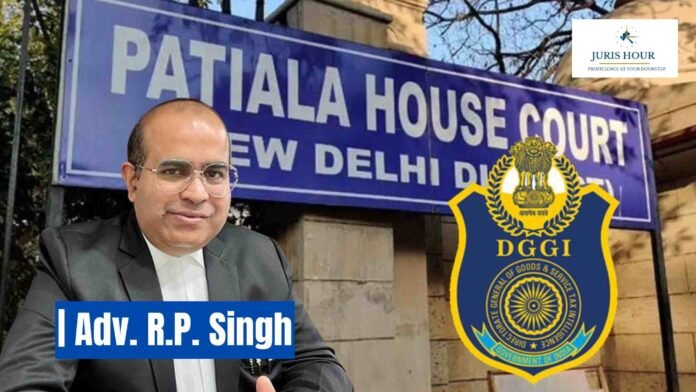
The Additional Sessions Judge, New Delhi, granted bail to Ashish Goyal, holding that non-communication of “reasons to believe” at the time of arrest constitutes a serious violation of Section 69(1) of the CGST Act.
The Court emphasized that the failure to communicate “reasons to believe” at the time of arrest strikes at the root of the legality of arrest and weighs heavily in favour of granting bail.
BUY NOW: GST E-Magazine Mega Combo (11 Publications)
The case arose from allegations that the accused was involved in operating a network of bogus firms engaged in issuing fake invoices without actual supply of goods, thereby facilitating fraudulent Input Tax Credit (ITC). The department alleged that multiple entities were created and controlled by the accused to pass on fake ITC and evade GST, causing a loss of approximately ₹113 crores to the exchequer.
During the proceedings, counsel for the accused argued that he had been falsely implicated and was subjected to illegal detention without being formally served with an arrest memo or informed of the “reasons to believe.” It was further contended that statements recorded under Section 70 of the CGST Act were not admissible without due compliance of procedural safeguards and that no recovery was pending which necessitated custodial interrogation.
On the other hand, the department opposed the bail plea, asserting that the accused was the mastermind behind a cartel of fictitious firms created solely for passing fraudulent ITC. The investigation revealed that several firms were registered using fake or unrelated identities, with no actual business activity at the declared premises. Statements of individuals allegedly involved indicated that invoices and GST returns were generated under the directions of the accused, often through coordinated efforts using digital communication channels such as WhatsApp groups.
Despite the serious nature of allegations, the Court examined whether statutory safeguards under Section 69(1) were followed. It noted that “reasons to believe” are a jurisdictional requirement and must be communicated to the accused. Relying on Supreme Court precedents, the Court observed that mere recording of reasons is insufficient unless they are furnished to the accused to enable them to challenge the arrest.
The Court categorically held that the failure to communicate such reasons renders the arrest procedurally flawed. It further recorded that in the present case, “reasons to believe” were never served upon the accused, amounting to a clear violation of statutory mandate.
The Court considered that the accused had been in custody since January 2026 and that no further recovery was required from him. It also noted that the alleged offence, though serious, carried a maximum punishment of five years, and prolonged custody was not justified in the absence of compliance with procedural safeguards.
In light of these findings, the Court exercised its discretion to grant bail, subject to conditions including furnishing a bond of ₹2,00,000, cooperating with the investigation, not tampering with evidence or witnesses, and appearing before the Court as required.
Case Details
Case Title: GST Versus Ashish Goyal
Case No.: 345/2026
Date: 28/02/2026
Counsel For Applicant: R.P. Singh

