
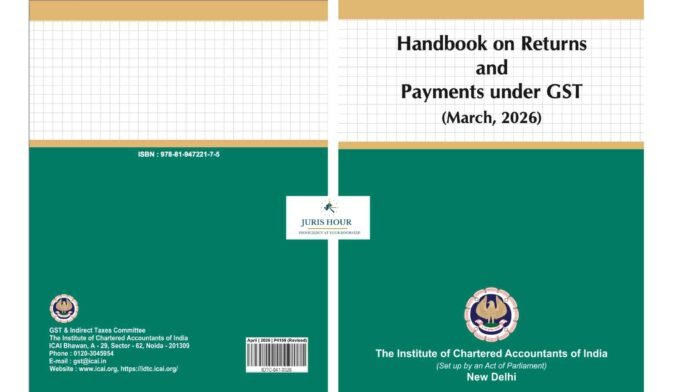
A revised handbook released by the Institute of Chartered Accountants of India (ICAI) highlights significant developments in the GST return filing and tax payment framework, emphasizing a shift towards a technology-driven, self-assessment based compliance system. The publication provides a comprehensive overview of return mechanisms, payment procedures, and recent regulatory updates aimed at enhancing transparency and efficiency.
The GST regime continues to be anchored in the principle of self-assessment, where taxpayers themselves determine and discharge their tax liability. Returns play a central role in this framework by acting as a complete declaration of outward supplies, inward supplies, input tax credit (ITC), and tax payments, making them the backbone of GST compliance.
One of the key highlights of the updated framework is the increasing reliance on system-based validations and automated processes. The introduction of the Invoice Management System (IMS) has strengthened invoice-level reconciliation, ensuring that input tax credit claims are closely linked with supplier disclosures. Additionally, automated mismatch intimations under Rules 88C and 88D have been introduced to flag discrepancies in tax liability and ITC, thereby reducing errors and improving compliance monitoring.
The handbook also underscores the growing importance of accurate and timely return filing, as GST compliance is now deeply integrated with digital systems. Delays or incorrect reporting can disrupt ITC flow and attract consequences such as late fees, interest liabilities, and even cancellation of registration in cases of persistent non-compliance.
Another significant development is the mandatory registration of Input Service Distributors (ISD) from April 1, 2025, aimed at streamlining the distribution of input tax credit across multiple units of a business. This move is expected to bring greater clarity and accountability in credit allocation.
The revised framework also elaborates on multiple GST return forms and their applicability, including GSTR-1 for outward supplies, GSTR-3B for tax payment, and GSTR-9 for annual returns. It highlights the role of schemes like QRMP (Quarterly Return Filing and Monthly Payment) for small taxpayers, allowing simplified compliance while maintaining monthly tax payment discipline.
Importantly, the GST system now operates as an interconnected compliance ecosystem, where supplier filings directly impact the recipient’s eligibility to claim ITC. This has effectively created a self-policing mechanism, reducing the scope for tax evasion and improving data consistency across the GST network.
The handbook further notes that the GST portal now provides enhanced visibility, including indicators showing the extent of tax liability discharged by suppliers, which can assist recipients in assessing ITC risks. However, it also acknowledges that full control over supplier compliance still remains a challenge for recipients.
Overall, the revised publication reflects a clear policy direction towards greater automation, tighter compliance checks, and improved transparency in GST return filing and tax payment processes. It serves as a practical guide for taxpayers and professionals navigating the evolving GST ecosystem and adapting to its increasingly digital compliance requirements.
Read More: JURISHOUR | TAX LAW DAILY BULLETIN : APRIL 13, 2026

