
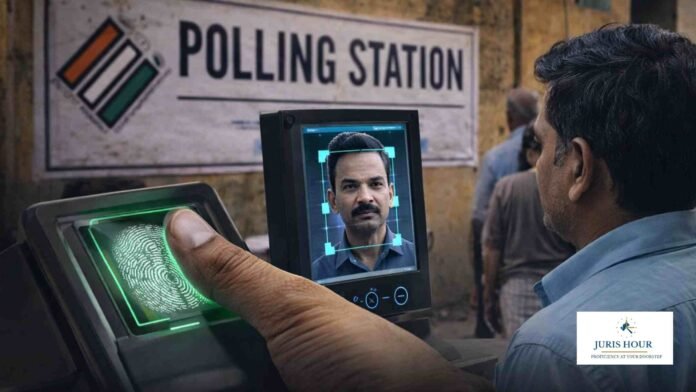
The Supreme Court has issued notice on a Public Interest Litigation filed by BJP leader Ashwini Upadhyay seeking the introduction of biometric and facial recognition verification of voters before casting votes to curb electoral malpractices such as impersonation, duplicate voting, and ghost voting.
The PIL, filed under Article 32 of the Constitution, urges the implementation of fingerprint, iris, and facial recognition-based authentication at polling booths to ensure that only genuine voters exercise their franchise. The petition argues that despite existing safeguards, instances of electoral fraud continue to undermine the credibility of elections.
During the hearing, the Bench led by CJI Surya Kant observed that such a reform would require substantial changes in the existing legal and procedural framework, along with a significant financial commitment. The Court noted that while the Election Commission of India (ECI) does possess the necessary powers, the implementation of such a system would not be straightforward.
Responding to the Court’s concerns, the petitioner submitted that the ECI has plenary powers under Article 324 to introduce such measures, but emphasized that cooperation from State governments would also be essential, particularly in terms of logistics and infrastructure. He further urged the Court to issue notice in the matter to initiate the process.
The Bench, however, initially expressed reservations about issuing notice at this stage, observing that the ECI should first be given an opportunity to respond. The Court remarked that if the proposal faces hurdles such as lack of support from States or absence of budgetary allocation from the Finance Ministry, the petitioner may approach the Court again at a later stage.
Clarifying the scope of the plea, the petitioner submitted that the request was not limited to the upcoming elections in five States, but was intended as a broader electoral reform measure. Taking note of this, the Court observed that the prayers in the petition cannot be considered for immediate implementation in ongoing or imminent elections, but the issue of adopting such a system for future parliamentary or state elections requires examination.
Accordingly, the Supreme Court directed that notice be issued, calling for a response from the Election Commission on the feasibility and implications of introducing biometric and facial recognition-based voter authentication.
The petition highlights several benefits of biometric verification, including prevention of duplicate and fraudulent voting, elimination of ghost voters, real-time authentication, and creation of a verifiable audit trail. It also argues that India already has the technological infrastructure to support such systems, drawing parallels with Aadhaar-based authentication frameworks.
Case Details
Case Title: ASHWINI KUMAR UPADHYAY Vs. UNION OF INDIA AND ORS.
Case No. W.P.(C) NO. 383/2026
Read More: ICAI Expands Mandatory Applicability of AQMM to Wider Set of Audit Firms

