
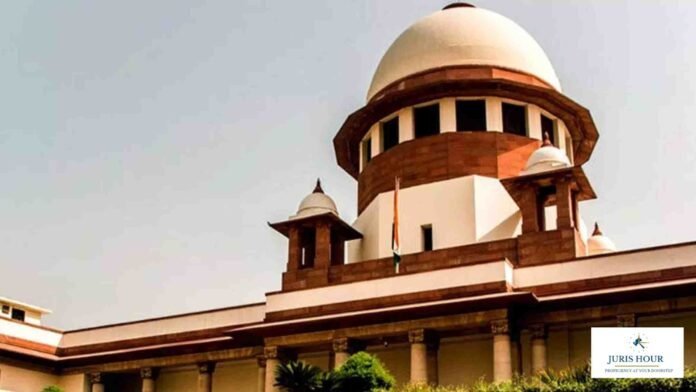
The Supreme Court has reaffirmed the primacy of merit in appointments under the unreserved category, even when horizontal reservations such as those for Persons with Disabilities (PWD) are involved.
The bench of Justice Sanjay Karol and Justice Nongmeikapam Kotiswar Singh has clarified the meaning of the recruitment notification clause, which stated that if no qualified Unreserved PWD-LV candidate is available, the post may be filled by candidates from other categories. The Court interpreted this clause as a fallback provision rather than a restrictive one, noting that it does not prohibit the selection of more meritorious candidates from reserved categories when they are available.
The case arose out of a recruitment process for the post of Junior Engineer (Civil), Grade-II, conducted by the West Bengal State Electricity Transmission Company. Among the vacancies, one post was earmarked for the Unreserved category under the PWD-LV (Persons with Disabilities – Low Vision) quota. The dispute centered around two candidates: one belonging to the Unreserved PWD-LV category who secured 55.667 marks, and another belonging to the OBC-A category but also classified under PWD-LV, who scored significantly higher at 66.667 marks.
Despite being from a reserved category, the higher-scoring OBC-A candidate was selected for the Unreserved PWD-LV post, leading to a legal challenge by the Unreserved candidate. The Single Bench of the Calcutta High Court upheld the selection based on merit. However, the Division Bench reversed this decision, holding that since a qualified Unreserved PWD-LV candidate was available, the post should have been filled strictly from that category.
The Supreme Court, however, disagreed with the Division Bench and restored the Single Bench’s decision. In its detailed analysis, the Court clarified that the “Unreserved” category is not a separate social category but an open pool accessible to all candidates, irrespective of caste or classification. It emphasized that for posts under horizontal reservations within the unreserved category, eligibility is determined by the special category—in this case, PWD-LV—and not by social classification.
The Court further explained that horizontal reservations, such as those for persons with disabilities, operate across all vertical categories like SC, ST, OBC, and Unreserved. Therefore, any candidate who satisfies the horizontal criteria can compete for such posts, regardless of their social category. In this context, the Court held that a more meritorious candidate from a reserved category is fully entitled to be selected against an Unreserved post if they meet the required criteria.
The Court rejected the interpretation adopted by the Division Bench that gave preference to a less meritorious Unreserved candidate merely because they belonged to the Unreserved category. It held that such an approach would undermine the fundamental principle that merit governs appointments in the Unreserved category. The Court stressed that allowing a less meritorious candidate to prevail over a more deserving one would be contrary to the equality principles enshrined in Articles 14 and 16 of the Constitution.
Another important aspect highlighted in the judgment is that candidates from reserved categories can be appointed to Unreserved posts only if they meet the eligibility criteria without availing any relaxation. In the present case, there was no evidence that the selected candidate had availed any such relaxation, thereby making his selection valid.
In conclusion, the Supreme Court allowed the appeal, set aside the Division Bench judgment of the Calcutta High Court, and upheld the appointment of the more meritorious OBC-A PWD-LV candidate. The ruling serves as a crucial precedent in reservation jurisprudence, reinforcing that merit cannot be compromised in the Unreserved category and that horizontal reservations must be applied in a manner that ensures fairness and equality for all eligible candidates.
Case Details
Case Title: The West Bengal State Electricity Transmission Co.Ltd & Ors. Versus Dipendu Biswas & Ors.
Citation: JURISHOUR-648-SC-2026
Case No.: CIVIL APPEAL NO.10262 OF 2025
Date: 07/04/2026

