
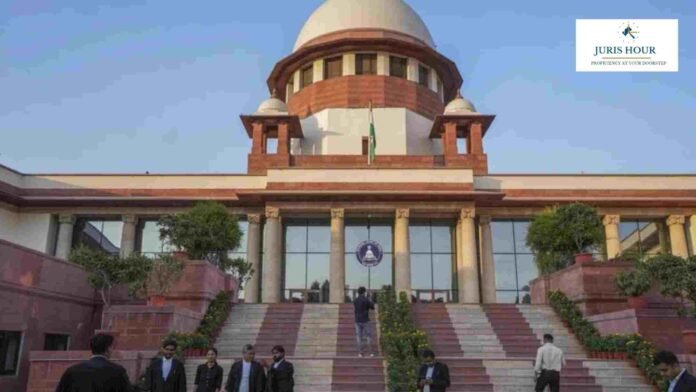
The Supreme Court has set aside a Calcutta High Court order and quashed criminal proceedings against three accused persons in a neighborhood dispute case from Kolkata, holding that the allegations were vague and unsupported by credible evidence, particularly in light of CCTV footage contradicting the prosecution’s claims.
The bench of Justice Vikram Nath, Justice Sandeep Mehta, and Justice N. V. Anjaria undertook a detailed examination of the case record and evidence. The bench placed significant reliance on CCTV footage collected during investigation, noting that the accused were not present during the alleged assault. They appeared only after the altercation had occurred. Their conduct suggested efforts to pacify the situation, not escalate it
The Court held that this electronic evidence “materially undermines the prosecution’s case” and contradicts the allegations made in the FIR.
The case arose from an incident dated October 11, 2022, at a residential apartment in South 24 Parganas, where a dispute allegedly escalated into verbal abuse and physical altercation. An FIR was registered under multiple provisions of the Indian Penal Code, including unlawful assembly, assault, criminal intimidation, and outraging modesty.
The accused persons, including Sajal Bose, challenged the criminal proceedings before the Calcutta High Court, seeking quashing of the chargesheet. While the High Court granted relief to two co-accused, it refused to quash proceedings against the remaining three, prompting them to approach the Supreme Court.
The complainant alleged that the accused persons physically assaulted him and his family members; threw objects, including sandals, and used a stick (lathi); attempted to forcibly enter his residence; issued threats and abusive language; and targeted him despite his medical condition (pacemaker).
However, the FIR largely contained generalized allegations without clearly specifying the individual roles of each accused.
The bench observed that the FIR and witness statements failed to attribute specific overt acts to the accused. Relied on omnibus allegations without clear details and did not establish the essential ingredients of the alleged offences
The Supreme Court criticized the High Court for not properly evaluating the CCTV footage and granting relief to some co-accused but denying it to others without clear reasoning, violating the principle of parity
The Court reiterated the principles laid down in State of Haryana v. Bhajan Lal, emphasizing that criminal proceedings can be quashed where allegations do not disclose a prima facie offence, evidence fails to support the prosecution, and roceedings are initiated with mala fide intent
The Supreme Court concluded that the allegations, even if taken at face value, do not establish any offence against the appellants. The CCTV evidence completely discredits the prosecution narrative. The case appears to be driven by personal disputes and mala fide intent
The Court quashed the chargesheet and all related criminal proceedings against the appellants, holding that continuing the trial would amount to an abuse of the process of law.
Case Details
Case Title: Sajal Bose Versus The State Of West Bengal And Ors.
Citation: JURISHOUR-626-SC-2026
Case No.: SLP(Criminal) No(s).8672 of 2024
Date: 06/04/2026

