
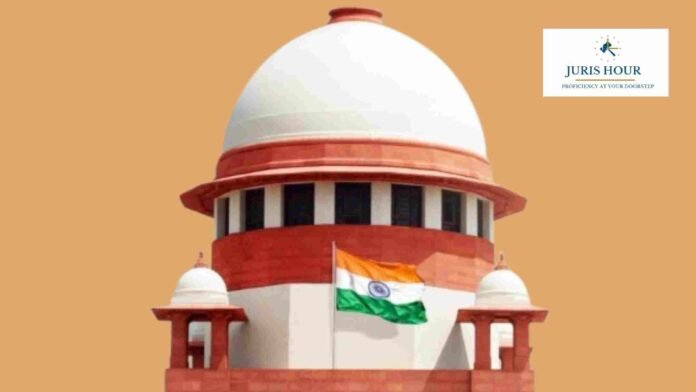
The Supreme Court has directed the Municipal Corporation Chandigarh to appoint two candidates to a single advertised post of Law Officer by creating a supernumerary position.
The bench of Justice Sanjay Karol and Justice Prashant Kumar Mishra observed that from a plain reading of the Constitution, the answer “Ninth Schedule” appears correct. However, in light of evolved constitutional interpretation, particularly the basic structure doctrine, the answer “None of the above” can also be justified.
The controversy stemmed from Question No. 73 in a written test conducted for recruitment to the post of Law Officer. The question asked which schedule of the Constitution is immune from judicial review on the ground of violation of fundamental rights.
While the recruiting authority treated “Ninth Schedule” as the correct answer, candidate Amit Kumar Sharma selected “None of the above,” arguing that no constitutional provision is absolutely immune from judicial review, especially in light of evolving jurisprudence.
Due to this discrepancy, Sharma lost marks owing to negative marking, affecting his overall ranking and chances of selection. Meanwhile, the selected candidate, Charan Preet Singh, secured the post.
The matter first reached the Punjab and Haryana High Court, where a Single Judge upheld the recruiting authority’s answer, emphasizing that Article 31B continues to provide immunity to laws placed in the Ninth Schedule.
However, the Division Bench reversed this finding, relying on the landmark judgment in I.R. Coelho v. State of Tamil Nadu. It held that such immunity is not absolute and remains subject to the “basic structure doctrine,” thereby accepting Sharma’s answer as legally valid.
The Supreme Court noted that even judges of the High Court differed in their interpretation of the correct answer, highlighting the complexity of the constitutional issue involved.
Referring to landmark precedents such as Kesavananda Bharati v. State of Kerala, the Court observed that determining the correct answer required deep constitutional analysis spanning decades of jurisprudence.
The Court concluded that expecting law graduates to resolve such a nuanced constitutional issue in a competitive exam setting was unreasonable.
In a balanced resolution, the Court directed the Municipal Corporation to create a supernumerary post and appoint Amit Kumar Sharma alongside Charan Preet Singh.
The Court further clarified that Charan Preet Singh, who had already joined service, would retain seniority.
Case Details
Case Title: Charan Preet Singh Versus Municipal Corporation Chandigarh & Ors.
Citation: JURISHOUR-420-SC-2026
Case No.: CIVIL APPEAL NO. 3446 OF 2026
Date: 17/03/2026

