
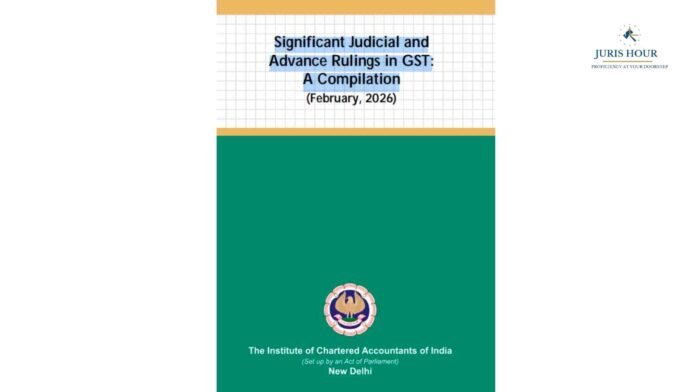
The Institute of Chartered Accountants of India (ICAI) has released the second edition of its publication titled “Significant Judicial and Advance Rulings in GST: A Compilation”, offering a comprehensive overview of landmark decisions shaping the Goods and Services Tax (GST) regime.
The publication, brought out by ICAI’s GST & Indirect Taxes Committee, collates and analyses important rulings of the Supreme Court and various High Courts, aimed at helping professionals and stakeholders navigate the evolving GST landscape.
Among the notable rulings featured in the compilation is a significant judgment of the Kerala High Court in the case involving the Indian Medical Association (IMA), which revisits the applicability of GST on member-based welfare schemes.
The case arose after tax authorities sought to levy GST on contributions collected by the IMA from its members for welfare schemes such as social security, disability support, and health benefits. The authorities treated these transactions as taxable “supply” under the GST framework.
In a major relief to associations and professional bodies, the Kerala High Court upheld the doctrine of mutuality, ruling that transactions between an association and its members cannot be treated as taxable supplies.
The Court struck down key provisions—Section 7(1)(aa) and Section 2(17)(e) of the CGST Act—as unconstitutional, holding that they improperly sought to treat associations and their members as separate entities for taxation purposes.
It observed that in mutual arrangements, there is no distinct supplier and recipient, as members effectively contribute to and benefit from a common pool. Therefore, such transactions fall outside the scope of GST.
A critical aspect of the ruling was the Court’s rejection of retrospective amendments introduced through the Finance Act, 2021. These amendments attempted to impose GST liability on such mutual transactions with effect from July 1, 2017.
The Court held that retrospective taxation in this context violates constitutional principles, particularly where taxpayers had no prior notice or opportunity to factor in such liabilities.

