
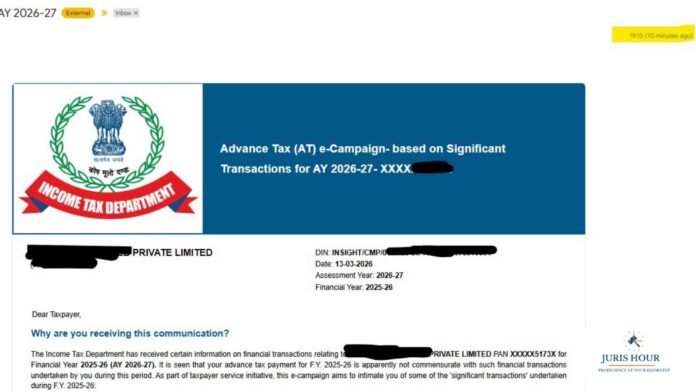
The Income Tax Department has begun sending advance tax e-campaign emails to taxpayers highlighting details such as GST turnover, purchases and other “significant financial transactions” as part of its data-driven compliance initiative.
The communication aims to remind taxpayers to review their advance tax obligations before the upcoming due date and ensure timely compliance.
The emails are understood to include information sourced from multiple data points, including GST filings and other financial transaction records available with the tax administration. By flagging these transactions, the department seeks to prompt taxpayers to reassess whether their advance tax liability has been adequately discharged for the financial year.
Tax professionals have broadly welcomed the move as a step towards proactive and technology-enabled compliance nudges. The use of data analytics by the Income Tax Department is seen as part of a broader effort to improve voluntary compliance and reduce instances of tax underpayment.
However, concerns have been raised over the timing of the emails. Many taxpayers reportedly received these communications on the evening of March 13, just two days before the advance tax deadline of March 15. With the intervening weekend leaving limited working days, taxpayers may find it difficult to analyse the data, evaluate their tax positions and make any additional advance tax payments if required.
Experts also emphasise that the presence of high transaction values or significant GST turnover does not automatically translate into advance tax liability. Advance tax becomes payable only when a taxpayer has taxable profits, insufficient tax deduction or collection at source (TDS/TCS) credits, and a net tax liability exceeding ₹10,000.
In several cases, businesses may report large GST turnover but operate on relatively thin margins, resulting in limited taxable income. Similarly, companies with adequate TDS coverage may not have any additional advance tax liability despite large transaction volumes.
Professionals suggest that issuing such e-campaign nudges earlier in the quarter would make the initiative more effective. Earlier communication would give taxpayers sufficient time to analyse the information, consult advisors if necessary and take corrective action where required.
While the initiative reflects the increasing use of data analytics by tax authorities to encourage compliance, experts believe that improved timing and clearer contextual explanations in the communications could further enhance its effectiveness for taxpayers.
Read More: MCA Portal to Remain Unavailable Overnight on March 13–14 Due to Scheduled Maintenance

