
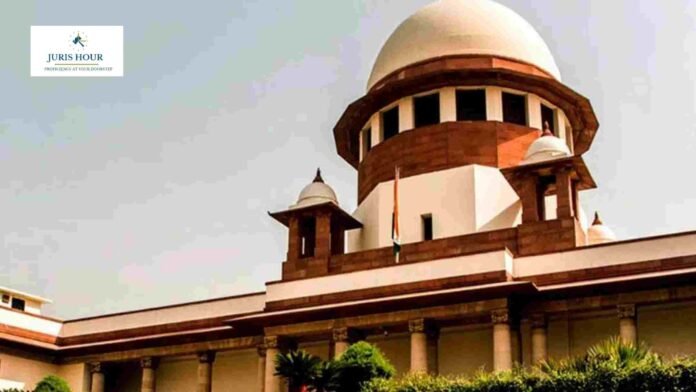
The Supreme Court has held that an acquittal granted on the benefit of doubt cannot automatically be treated as an honourable acquittal for the purpose of public employment, particularly in police services.
The bench of Justices N. V. Anjaria and Justice Ahsanuddin Amanullah allowed an appeal filed by the State of Madhya Pradesh and set aside a decision of the Madhya Pradesh High Court which had directed reconsideration of the candidature of Rajkumar Yadav.
The dispute arose from a recruitment process initiated in 2016 for the post of Constable (Driver) in the Madhya Pradesh Police. Rajkumar Yadav had successfully cleared the selection process and secured a position in the merit list under the unreserved category.
However, during the character verification stage, the screening committee found that Yadav had previously been accused in a criminal case involving serious offences, including allegations of kidnapping, abduction of a minor girl, and rape. Although the trial court had acquitted him in September 2014, the acquittal was granted on the benefit of doubt rather than a clear finding of innocence.
Taking these circumstances into account, the screening committee concluded that Yadav was unsuitable for appointment in the police force, a disciplined service requiring personnel of impeccable character.
Yadav challenged the decision before the Madhya Pradesh High Court. A Single Judge dismissed his petition and upheld the decision of the screening committee. However, the Division Bench reversed this ruling in July 2023, holding that the acquittal should be treated as a clean and honourable acquittal.
The Division Bench quashed the rejection order and directed the authorities to reconsider Yadav’s appointment within 60 days.
Aggrieved by this decision, the State of Madhya Pradesh approached the Supreme Court.
The Supreme Court emphasised that maintaining integrity and public confidence in the police force is of paramount importance. The bench observed that the character and background of candidates seeking entry into disciplined services must be carefully scrutinised.
The Court noted that the screening committee had considered the seriousness of the allegations and the nature of the acquittal before arriving at its decision. It clarified that an acquittal based on benefit of doubt does not automatically erase concerns about suitability for public service, particularly in roles involving law enforcement.
The bench also criticised the High Court’s Division Bench for interfering with the discretionary assessment made by the screening committee. According to the Court, the Division Bench had entered into the functional domain of the administrative authority without sufficient justification.
The Supreme Court held that the screening committee was within its powers to evaluate the candidate’s antecedents and determine suitability. The acquittal of the respondent was not an honourable acquittal, but one granted on benefit of doubt. Courts should exercise caution before overriding administrative decisions relating to recruitment in disciplined forces, especially when such decisions are based on character verification.
Allowing the appeal filed by the State of Madhya Pradesh, the Supreme Court set aside the July 2023 judgment of the Division Bench of the Madhya Pradesh High Court.
The court restored the decision of the Single Judge, which had upheld the screening committee’s rejection of the candidate.
Consequently, the rejection of Rajkumar Yadav’s candidature for the post of police constable remains valid.
Case Details
Case Title: The State Of Madhya Pradesh Versus Rajkumar Yadav
Citation: JURISHOUR-333-SC-2026
Case No.: CIVIL APPEAL NO. 3279 OF 2026
Date: 11/03/2026

