
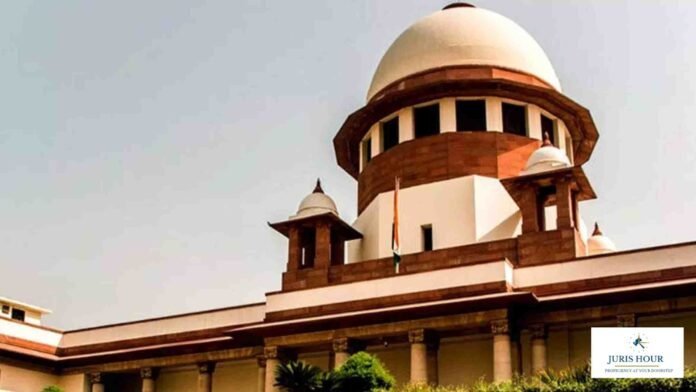
The Supreme Court of India has struck down the Srimati Radhika Sinha Institute and Sachchidanand Sinha Library (Requisition & Management) Act, 2015, holding that the legislation was manifestly arbitrary and violative of Article 14 of the Constitution.
A Bench led by Justice Vikram Nath allowed the appeal filed by Anurag Krishna Sinha and set aside the 2024 judgment of the Patna High Court, which had earlier upheld the validity of the Act enacted by the Government of Bihar.
The dispute concerned the Smt. Radhika Sinha Institute and Sachchidanand Sinha Library, an institution established in 1924 by noted public figure Sachchidanand Sinha in memory of his wife Radhika Sinha. The institute was set up as a trust and intended to function as a centre for intellectual and cultural activities.
In 2015, the Bihar legislature enacted a law enabling the State government to requisition and assume management of the institute and library. The statute effectively transferred control of the institution from the trustees to the State.
The move was challenged before the High Court, with the petitioner arguing that the legislation arbitrarily extinguished the rights of the trust and its trustees and amounted to unconstitutional state interference.
The appellant contended that the law was manifestly arbitrary, violating the equality guarantee under Article 14. Resulted in deprivation of property without adequate safeguards, contrary to constitutional protections under Article 300A. Interfered with the functioning of a trust governed under general law, including the Indian Trusts Act, 1882.
The State government defended the law by asserting that the takeover was necessary to ensure better management and preservation of the historic institution for public benefit.
The Supreme Court recognised that legislation can be invalidated if it is capricious, irrational, or lacking a determining principle, thereby violating Article 14.
The Bench found that the Bihar law allowed the State to displace the existing trust structure without sufficient justification or safeguards. The Court observed that less intrusive mechanisms—such as financial support or regulatory oversight—could have been adopted instead of a complete takeover.
Concluding that the statute failed constitutional scrutiny, the Court held that the Act was manifestly arbitrary in both design and operation.
Accordingly, the Supreme Court declared the Srimati Radhika Sinha Institute and Sachchidanand Sinha Library (Requisition & Management) Act, 2015 unconstitutional and set aside the Patna High Court’s ruling.
The Court restored management of the institute and library to the original trust structure. The Court clarified that the State government may still provide financial or administrative assistance in accordance with law but cannot take over the institution through an unconstitutional statute.
Case Details
Case Title: Anurag Krishna Sinha Versus State Of Bihar & Anr.
Citation: JURISHOUR-301-SC-2026
Case No.: Civil Appeal No. 13581 Of 2025
Date: 10/03/2026

