
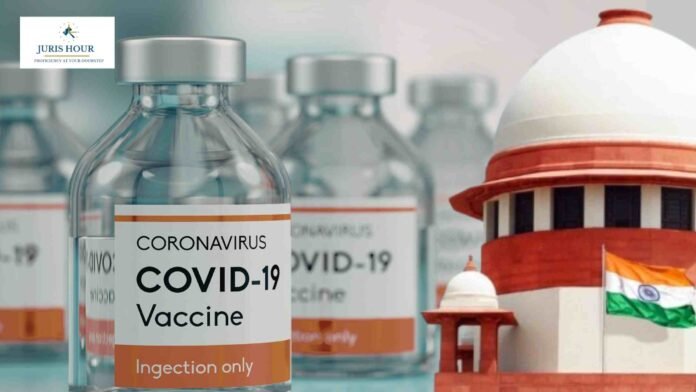
The Supreme Court has directed the Union government to formulate a “no-fault compensation policy” for individuals who suffer serious adverse events following COVID-19 vaccination, while declining to constitute a separate court-appointed expert body to investigate such cases.
The bench of Justices Vikram Nath and Sandeep Mehta issued the direction while disposing of a batch of petitions which raised concerns about deaths allegedly linked to COVID-19 vaccination and sought compensation for affected families.
The lead petition was filed by parents who alleged that their two daughters died after receiving COVID-19 vaccines. According to the petitioners, one daughter developed Cerebral Venous Sinus Thrombosis (CVST) following vaccination, while the other allegedly suffered multisystem inflammatory syndrome before passing away.
The petitioners urged the Court to establish an independent medical expert committee to examine adverse events following immunisation (AEFI), ensure transparent investigation of vaccine-related deaths, and grant compensation to families of victims.
Related petitions were also filed before the Kerala High Court, including one by a woman seeking recognition of her husband’s death as a vaccine-related adverse event and compensation for the family. These cases were later transferred to the Supreme Court for consideration.
The Supreme Court acknowledged the profound loss suffered by families during the COVID-19 pandemic and noted that issues concerning vaccine safety and public health policy must be approached with caution and scientific expertise.
The bench observed that the government already has mechanisms in place for monitoring and assessing adverse events following immunisation, which involve review by expert medical committees.
While the petitioners sought the creation of a court-supervised independent expert body, the Court declined the request, holding that the existing institutional framework for scientific evaluation of adverse events is sufficient.
The Court emphasised that judicial intervention should remain within constitutional limits, especially in matters involving public health policy and medical evaluation.
At the same time, the Court noted that many countries have implemented vaccine injury compensation programmes to address rare but serious adverse reactions.
Recognising the need for a compassionate and fair approach, the Court directed the Union government to formulate a “no-fault compensation policy” for individuals who suffer serious adverse events following COVID-19 vaccination.
Under such a system, compensation can be provided without requiring victims to establish negligence or fault, thereby ensuring timely relief.
The Court clarified that its order does not bar affected individuals from pursuing other remedies available under law.
It also emphasised that the creation of a no-fault compensation framework should not be interpreted as an admission of liability on the part of the government or vaccine manufacturers.
With these directions, the Supreme Court disposed of the writ petitions and connected matters, leaving it to the Union government to design an appropriate compensation mechanism.
Case Details
Case Title: Rachana Gangu & Anr. Versus Union Of India & Ors.
Citation: JURISHOUR-299-SC-2026
Case No.: Writ Petition (Civil) No.1220 Of 2021
Date: 10/03/2026

