
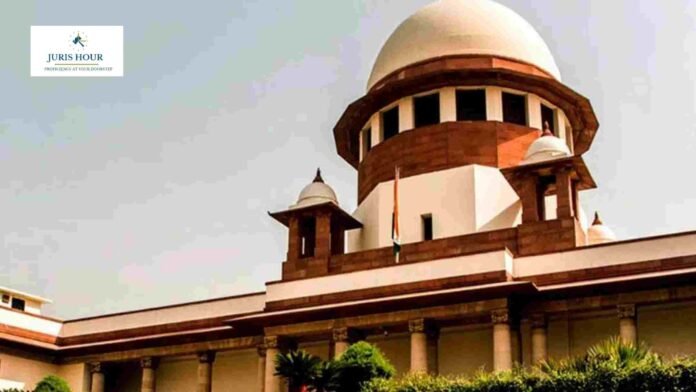
The Supreme Court has quashed criminal proceedings against the parents-in-law of a complainant woman, holding that vague and general allegations without specific roles cannot justify continuation of a criminal trial.
The bench of Justice Vikram Nath and Justice Sandeep Mehta while allowing the appeal filed by the accused parents-in-law and setting aside the order of the Patna High Court to the extent that it refused to grant them relief.
The dispute arose from a matrimonial conflict following the marriage of the complainant with the son of the appellants on July 8, 2019. Subsequently, the husband filed a divorce petition in March 2021 before the Family Court in Darbhanga, Bihar.
Nearly a year later, in March 2022, the complainant lodged an FIR alleging cruelty, assault, and dowry harassment against her husband, parents-in-law, and sister-in-law. The FIR invoked Sections 341, 323, 498A and 34 of the Indian Penal Code, along with Sections 3 and 4 of the Dowry Prohibition Act, 1961.
The complainant alleged that after the marriage she was subjected to harassment and torture due to demands for a BMW car and other valuable articles. She also claimed that the accused persons collectively attempted to strangulate her using a sheet.
Following investigation, the police filed a report and the Judicial Magistrate took cognizance of the alleged offences against all the accused persons.
The accused approached the Patna High Court seeking quashing of the criminal proceedings under Section 482 of the Code of Criminal Procedure.
In its order dated August 8, 2023, the High Court granted relief only to the sister-in-law, observing that the allegations against her were general and omnibus and insufficient to sustain criminal prosecution. However, it refused to quash proceedings against the parents-in-law, holding that a prima facie case existed against them.
Aggrieved by this differential treatment, the parents-in-law approached the Supreme Court.
The Supreme Court found that the High Court had applied inconsistent standards while evaluating the allegations against the accused persons.
The bench noted that a comparative reading of the FIR showed that the allegations against the parents-in-law and the sister-in-law were materially identical, with no specific or distinct acts attributed to the parents-in-law.
The Court observed that the FIR did not contain any particular dates, places, or overt acts showing the involvement of the appellants. The only allegation against them was that they would quarrel, which by itself could not constitute the offences alleged under the IPC or the Dowry Prohibition Act.
According to the Court, if the High Court considered the allegations against the sister-in-law insufficient to continue criminal proceedings, the same reasoning should logically apply to the parents-in-law as well.
The Court also took note of the timeline of events, pointing out that the husband had filed a divorce petition in March 2021, while the criminal complaint was lodged nearly a year later in March 2022.
While clarifying that delay alone cannot justify quashing criminal proceedings, the Court observed that when such delay is coupled with absence of specific allegations, it may support the argument that the complaint was filed as a counter-blast to matrimonial litigation.
Importantly, the Supreme Court clarified that its observations were limited to the case of the parents-in-law. The husband had not sought quashing of the criminal case and was not a party to the appeal before the Court.
Accordingly, the Court stated that criminal proceedings against the husband would continue in accordance with law.
Allowing the appeal, the Supreme Court set aside the High Court’s order to the extent that it refused relief to the parents-in-law and quashed all criminal proceedings against them arising out of the FIR registered in 2022.
Case Details
Case Title: Dr. Sushil Kumar Purbey & Anr. Versus The State Of Bihar And Ors.
Citation: JURISHOUR-271-SC-2026
Case No.: SLP(CRL.) NO.3075/2024
Date: 09/03/2026
Read More: Additional Evidence Can’t Be Used to Fill Lacuna in Appeal: Supreme Court

