
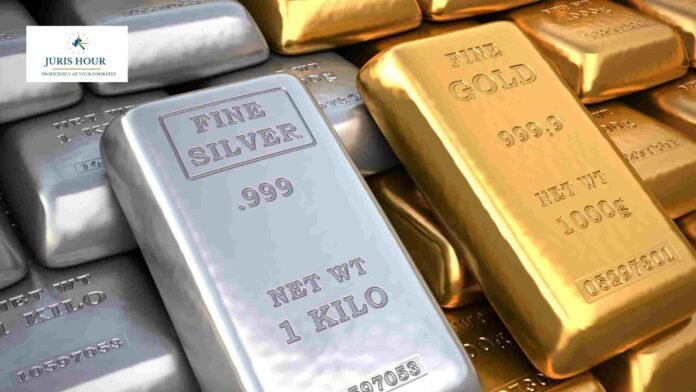
Fund of Funds (FoFs) investing in gold and silver exchange-traded funds (ETFs) have become an increasingly popular avenue for retail investors seeking exposure to precious metals. These schemes are particularly attractive to those without demat accounts or investors who prefer systematic investment plans (SIPs) over lump-sum trading.
In principle, FoFs should closely track the performance of their underlying ETFs, which themselves aim to mirror domestic gold and silver prices. Since FoFs invest almost entirely in ETF units, investors often assume that returns across the metal, the ETF, and the FoF should broadly align. However, recent data suggests that this assumption does not always hold true in practice.
A noticeable return gap
Data compiled by ACEMF for the one-year period ending February 5, 2026, highlights a meaningful divergence in performance. During this period, domestic gold prices climbed by around 77.5 per cent, a rise that was largely reflected in gold ETF returns. Gold FoFs, however, delivered a wider range of outcomes, with returns varying between 72 per cent and 78 per cent.
The divergence was even more pronounced in silver. Domestic silver prices surged by approximately 155 per cent over the same period, with silver ETFs broadly matching this rally. Silver FoFs, on the other hand, recorded returns ranging from about 147 per cent to 157 per cent.
While this snapshot captures just one point in time, a rolling one-year return analysis covering the past two years shows a consistent pattern. Importantly, the gap between ETFs and FoFs does not remain constant. It tends to widen sharply during strong uptrends in metal prices and narrow during relatively stable or sideways market phases.
Why FoFs diverge from ETFs?
Two key aspects explain this phenomenon: performance differences among FoFs themselves, and the structural return gap between ETFs and FoFs.
Timing and execution risk
FoFs operate like conventional mutual funds and follow a 3 PM cut-off for subscriptions and redemptions. By around 3:05–3:10 PM, fund houses have clarity on net inflows or outflows for the day. These funds then deploy the money to purchase ETF units, typically between 3:10 PM and market close, at prevailing market prices—not at the ETF’s end-of-day net asset value (NAV).
ETFs, unlike FoFs, trade on stock exchanges throughout the day, and their market prices can deviate from their indicative NAVs. If an ETF is trading at a premium or discount during the narrow execution window used by the FoF, the FoF may end up buying at unfavourable prices. This difference directly feeds into the FoF’s NAV and creates a performance gap relative to the ETF.
NAV calculation method
Another structural issue arises from how FoFs compute their NAV. FoFs value their holdings using the ETF’s closing market price, not the ETF’s underlying NAV, which is published after market hours. Any distortion in the ETF’s closing price—whether due to thin liquidity or late-session volatility—is automatically reflected in the FoF’s NAV.
ETF premiums or discounts often emerge when demand-supply imbalances, low trading volumes, or insufficient market-making activity push prices away from intrinsic value. While authorised participants and market makers generally help keep ETF prices aligned with NAVs, this mechanism is not always effective during periods of stress or sharp price moves. FoFs, which do not trade on exchanges themselves, inherit these inefficiencies.
Some asset management companies attempt to mitigate this risk by using the ETF’s NAV instead of its market price when deviations exceed a predefined threshold, often around 3 per cent. However, this practice is not uniformly followed across the industry.
Smaller ETFs with limited liquidity are especially vulnerable to price distortions during the final minutes of trading, when FoFs typically execute their purchases. In contrast, larger ETFs with deeper liquidity, tighter bid–ask spreads, and active market makers tend to offer more efficient price discovery, reducing the likelihood of adverse execution.
Why FoFs often lag ETFs over time?
A simple analysis of one-year rolling returns over the past two years suggests that FoFs, on average, delivered about 1.4 per cent lower returns than their corresponding ETFs when measured against ETF closing prices.
Several factors contribute to this gap:
Cash drag
FoFs, like all mutual funds, maintain small cash balances to manage liquidity needs arising from subscriptions and redemptions. During strong rallies in gold or silver, this uninvested cash earns negligible returns, creating an opportunity cost. That said, cash drag has not been a major driver of underperformance in recent periods. Over the past year, gold FoFs held an average cash balance of around 0.8 per cent, while silver FoFs held about 0.2 per cent, indicating that most schemes were nearly fully invested.
Layered expense structure
FoFs inherently carry a dual expense burden. The underlying ETF charges its own total expense ratio (TER), which for gold ETFs typically ranges from 0.3 to 0.8 per cent, and for silver ETFs from about 0.33 to 0.58 per cent (as of December 2025). On top of this, FoFs levy an additional expense, with gold FoFs charging roughly 0.35 to 1 per cent and silver FoFs about 0.5 to 1 per cent under regular plans.
Compounding impact of premiums and costs
Perhaps the most significant long-term impact comes from compounding. When a FoF purchases ETF units at a premium, it effectively acquires fewer units for the same investment. Over time, as metal prices rise, the value gap widens because gains compound on a smaller base.
For instance, an investment of ₹10,000 into an ETF priced at ₹100 yields 100 units. If a FoF buys the same ETF at a 2 per cent premium, it acquires only about 98 units. If the metal price later rises by 50 per cent, those 98 units are worth ₹14,700, compared to ₹15,000 for the ETF investor. In flat markets, this difference remains modest, but in prolonged bull runs, the wealth erosion becomes increasingly visible.
What investors should consider?
ETFs are generally better suited for informed investors who hold demat accounts, actively track market prices, and are comfortable monitoring liquidity, bid–ask spreads, and tracking error. They offer lower costs and more direct exposure to metal prices.
FoFs, on the other hand, cater to investors who value simplicity, SIP convenience, and freedom from operational complexity, even if that comes at the cost of slightly higher expenses and occasional return divergence.
Just as investors scrutinise ETFs for liquidity, corpus size, tracking error, and expense ratios, similar diligence should be applied when selecting FoFs. Choosing FoFs that invest in the most liquid and actively traded ETFs can significantly reduce structural return drag.
Investors should also avoid impulsive purchases or redemptions during days of extreme price movements, when ETF premiums or discounts can widen sharply, increasing the risk of transacting far from fair value.
Based on one-year rolling return data over the past two years, gold FoFs such as Nippon India Gold Savings Fund, SBI Gold Fund, and HDFC Gold ETF FoF have generally remained closer to their underlying ETFs and domestic gold prices. In the silver category, Nippon India Silver ETF FoF, HDFC Silver FoF, and UTI Silver ETF FoF appear to have delivered relatively more consistent outcomes.
While FoFs remain a useful tool for precious metal exposure, understanding their structural nuances can help investors set realistic expectations and make more informed choices.
Read More: Replacing Dies and Moulds Is Not Capital Spend: Madras HC Upholds Relief to TVS Motor

