
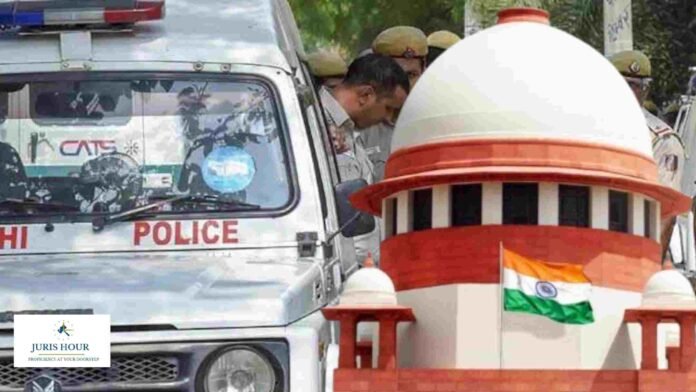
The Supreme Court has ruled that once a closure report filed under Section 173(2) of the Criminal Procedure Code (CrPC) is accepted by a Magistrate, the police or any executive authority cannot direct further investigation on its own without obtaining prior permission from the competent court. Setting aside the Allahabad High Court’s judgment, the Court quashed orders issued by Uttar Pradesh authorities that had directed a fresh round of investigation nearly seven years after the case was closed.
A Bench of Justices Rajesh Bindal and Vijay Bishnoi held that while Section 173(8) permits further investigation even after submission of a final report, the power to direct such investigation rests exclusively with the Magistrate or a higher court—not with the police or executive authorities.
The case arose from an FIR registered in November 2013 at a Mahila Police Station in Firozabad district, Uttar Pradesh, alleging gang rape and other offences under the Indian Penal Code. After multiple transfers of investigation—from the local police to the Crime Branch—the investigating agency filed a final report in May 2014 concluding that no offence was made out. The report cited contradictions in witness statements, lack of medical evidence, and call detail records showing that the accused were not present at the alleged spot.
In September 2015, the Judicial Magistrate accepted the closure report after issuing repeated notices to the complainant, who neither appeared nor filed a protest petition. The criminal proceedings thus stood closed.
Several years later, a complaint was made before the National Human Rights Commission (NHRC), which pointed out alleged deficiencies in the investigation and recommended a fact-finding inquiry. Acting on these directions, the State Government transferred the matter to the CBCID and, through official communications dated June 6, 2019, and April 26, 2021, directed further investigation under Section 173(8) CrPC.
During this renewed investigation, DNA samples of the accused were collected. A forensic report later concluded that none of the accused were the biological father of the prosecutrix’s aborted foetus.
The accused challenged these executive orders before the Allahabad High Court, which refused to interfere, prompting an appeal to the Supreme Court.
The central question before the Court was whether the police or the State Government can order “further investigation” under Section 173(8) CrPC after a final report has been accepted by a Magistrate, without first obtaining the court’s permission.
Relying on earlier landmark rulings such as Vinay Tyagi v. Irshad Ali, Vinubhai Haribhai Malviya v. State of Gujarat, and Peethambaran v. State of Kerala, the Court reiterated that seeking leave of the court for further investigation is a well-established legal practice and a necessary safeguard against abuse of power.
The Court strongly criticised the conduct of senior police officials who ordered further investigation without judicial approval, observing that such actions undermine the authority of courts and violate settled legal procedure.
The Supreme Court set aside the Allahabad High Court judgment dated November 20, 2023. The State Government and police communications dated June 6, 2019, and April 26, 2021, directing further investigation.
The Court clarified that its findings would not prejudice the pending criminal revision filed by the original complainant against the acceptance of the closure report, which would be decided independently on its own merits.
Case Details
Case Title: Pramod Kumar & Ors. Versus State Of U.P. & Ors.
Case No.:SLP (CRIMINAL) NO. 350 OF 2024
Date: 04/02/2026

