
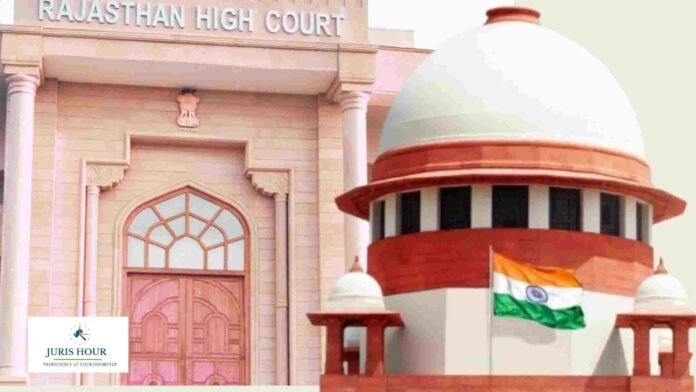
The Supreme Court has ruled that when an arbitrator is appointed by a court under Section 11 of the Arbitration and Conciliation Act, 1996 before the 2015 amendments, the existence and validity of the arbitration clause cannot be reopened at later stages of the proceedings.
The bench of Justice J.B. Pardiwala and Justice K. V. Viswanathan has observed that that such an appointment operates as res judicata between the parties and binds them throughout the arbitral process, including challenges under Section 34 of the Act.
The ruling came in appeals challenging a Rajasthan High Court decision that had upheld the setting aside of an arbitral award on the ground that the dispute-resolution clause in the contract was not an arbitration clause. The Supreme Court examined whether courts below were justified in re-examining the nature of the clause after an arbitrator had already been appointed by a competent court prior to the 2015 amendments.
The dispute arose from a construction contract awarded by a public housing authority, where disagreements surfaced over payment of escalation costs. The contractor invoked the dispute-resolution mechanism contained in the agreement, which provided for reference to an empowered Standing Committee. When the committee was allegedly not constituted in accordance with the contract, a petition under Section 11 was filed before the High Court, which appointed a sole arbitrator. That order was accepted by the respondent authority and was never challenged.
The arbitrator later passed an award in favour of the contractor. However, the award was set aside by the Commercial Court under Section 34, which held that the relevant contractual clause did not amount to an arbitration agreement. The High Court affirmed this view, relying on earlier High Court rulings that had interpreted similar clauses as non-arbitral.
Setting aside these decisions, the Supreme Court emphasised that the appointment of the arbitrator had taken place during the legal regime laid down in SBP & Co. v. Patel Engineering Ltd., when courts exercising powers under Section 11 were required to decide not only the existence but also the validity of the arbitration agreement. The Court reiterated that under this regime, the Section 11 court’s determination is judicial in nature and attains finality under Section 11(7) of the Act.
The Court clarified that even if the Section 11 order did not expressly record a detailed finding on the arbitration clause, the very act of appointing an arbitrator necessarily implied a conclusion that a valid arbitration agreement existed. Once such an order is accepted and allowed to attain finality, parties are barred from questioning the arbitration clause before the arbitral tribunal or at later stages, including in proceedings under Section 34.
Drawing a distinction between precedent and res judicata, the Supreme Court held that while earlier High Court judgments on similar clauses may operate as precedents in other cases, they cannot override the binding effect of a final Section 11 order between the same parties. The Court observed that the Commercial Court had erred by treating the Section 11 order as lacking binding force and by reopening an issue already concluded between the parties.
The Bench also contrasted the legal position with the post-2015 framework, noting that after the insertion of Section 11(6A), courts are confined to a prima facie examination of the existence of an arbitration agreement, leaving substantive issues of validity to be decided by the arbitral tribunal. However, since the present proceedings commenced before the amendment came into force, the earlier and wider scope of judicial scrutiny continued to apply.
Allowing the appeals, the Supreme Court set aside the judgments of the High Court and the Commercial Court insofar as they held the dispute-resolution clause to be non-arbitral. The matter has been remitted to the Commercial Court for reconsideration of the Section 34 challenge on grounds other than the existence or validity of the arbitration clause.
Case Details
Case Title: M/s Eminent Colonizers Private Limited Versus Rajasthan Housing Board and Ors.
Case No.: SLP (C) No.8299 OF 2021
Date: 04/02/2026
Read More: MSMED Act Applicable to Works and Service Contracts, Not Limited to Goods Supply: Madras High Court

