
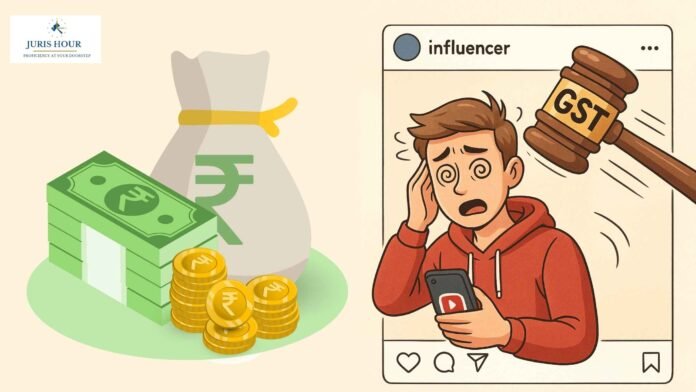
In a significant reminder for small businesses, influencers, and service providers who use social media as a marketing tool, the Andhra Pradesh High Court has recently highlighted how posts on platforms like Instagram and Facebook can be used as evidence for GST assessments.
The case of Sri Vasavi Wedding and Event Planners (W.P. No. 10250 of 2022, decided on July 14, 2022) demonstrates how online promotional content may turn into a crucial document in a tax investigation.
Case That Shows the Trend: Facebook Posts Used as Basis for GST Demand
The Andhra Pradesh High Court has dismissed a writ petition filed by an event management firm challenging a GST assessment order, holding that the dispute involved several factual questions that must be adjudicated before the Appellate Authority rather than under writ jurisdiction.
A Division Bench of Justice C. Praveen Kumar and Justice Tarlada Rajasekhar Rao has observed that the department had collected prima facie evidence of event-related activities through the petitioner’s own Facebook page.
According to the petitioner, the firm was engaged in event management services with its GST registration effective from July 1, 2017. The registration was later cancelled from August 1, 2020 at the petitioner’s own request.
The petitioner argued that her business operations were severely affected due to repeated medical emergencies involving her husband, who suffered paralytic strokes in August 2018 and again in August 2020. Due to his prolonged treatment in Hyderabad, she claimed that only a few small-scale events were organised up to January 2020, and none thereafter.
The petitioner further relied on the impact of the COVID-19 pandemic, pointing out that restrictions from March 2020 to August 2021 did not allow any gatherings beyond limited numbers, thereby preventing her from conducting commercial events.
Despite this, following an authorization issued under Section 71 of the APGST Act, officials visited her premises in November 2021 while she was away in Hyderabad. A statement given in December 2021 explained her circumstances and furnished details of returns filed from July 2017 to March 2020.
However, a show cause notice dated January 6, 2022 was issued proposing substantial tax liability—Rs. 18 lakh IGST, Rs. 26.55 lakh SGST, and Rs. 26.55 lakh CGST—based on alleged events traced through Facebook uploads.
Although the petitioner’s husband appeared before the authorities on February 10, 2022 and sought ten days’ time to respond, he could not submit a reply due to health issues. The authorities later passed the assessment order, leading to the present writ petition alleging violation of natural justice and arbitrary reliance on social media posts.
The Bench rejected the argument that no opportunity of hearing was provided. It noted that the department had issued notices for objection and personal hearing, additional time was granted on request, and the petitioner failed to respond despite being given chances.
Thus, the Court held there was no violation of natural justice.
The petitioner had contended that Facebook uploads were posted only for advertising purposes and did not reflect actual events conducted. The Court, however, observed that the assessment order contained specific details of multiple events—dates, venues, and proposed turnover—which the authorities had gathered from the petitioner’s own online platform.
The list included weddings, receptions, pre-wedding functions, birthday events, and ceremonies conducted between 2017 and 2021 at venues across Hyderabad, Bangalore, Vijayawada, Guntur, and other locations.
Based on this, the Court concluded that it could not be prima facie stated that no events were conducted during the disputed tax period.
Since the dispute involved detailed factual examination—such as determining whether events were actually conducted and whether the turnover estimations were justified—the Court held that such issues were best suited for adjudication before the statutory Appellate Authority.
The writ petition was dismissed, with liberty to the petitioner to file an appeal and raise all factual objections before the competent authority. The Court also clarified that its observations were only for disposal of the writ and would not influence the appellate proceedings.
Why This Matters: Social Media Is Now a Tax Evidence Trail
This ruling reinforces a major trend:
Digital footprints are becoming admissible triggers for tax scrutiny.
Whether you run an event business, a boutique, a travel service, or even act as a social media influencer, your public posts can be:
- Scrutinised for undeclared business activity
- Used to cross-verify GST turnover
- Treated as evidence of supply of services
- Relied upon to estimate taxable value
The line between “advertisement” and “actual business activity” can become blurry when photos and videos show detailed setups, venues, and client events.
‘Reel’ Today, ‘Record’ Tomorrow: What Businesses Should Learn
1. Every Post Adds to Your Digital Compliance Footprint
If your Instagram or Facebook page shows events, products, or customer services, tax departments may treat it as proof of actual business conducted.
2. Corrections and Clarifications Matter
If your posts are only for promotional purposes, you should maintain clear records explaining the nature of each upload.
3. Maintain Documentation for Each Event or Project
Invoices, contracts, cancellation emails, and client confirmations must be safely preserved to counter any assumptions drawn from social media.
4. Ensure GST Returns Match Your Public Image
If your brand exhibits a vibrant, active business online but your GST filings show low or no turnover, it naturally raises red flags.
What the AP High Court’s Decision Signals for the Future
The judgment shows the judiciary acknowledges the legitimacy of digital evidence in tax matters. What you upload online—photos, reels, stories, or client tags—is not just marketing material anymore. It can become a tool for assessing:
- Supply of services
- Place of supply
- Applicable GST rate
- Estimated turnover
The phrase “Your Instagram Reel Today Can Become a GST Evidence Exhibit Tomorrow” is no longer a warning—it is now a demonstrated reality.

