
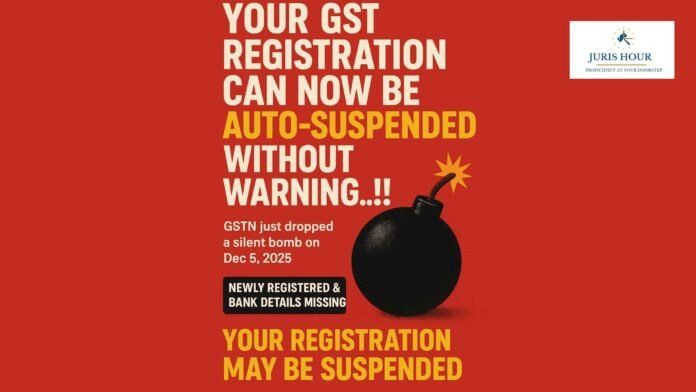
GSTN has implemented a strict automatic suspension mechanism under amended Rule 10A of the CGST Rules. Every newly registered taxpayer must furnish their bank account details within a fixed compliance window. If the mandated details are not uploaded in time, the registration will move into auto-suspension mode without any prior notice.
This provision applies to all standard registered taxpayers except specific exempt categories.
Mandatory Timeline Under Rule 10A
A newly granted GST registration now triggers the following compliance clock:
| Requirement | Timeline |
| Furnish Bank Account Details | Within 30 days of GST registration approval OR before filing the first GSTR-1/IFFwhichever is earlier |
| Filing of Returns without Bank Update | Not permitted |
| Non-Compliance Result | Immediate auto-suspension of GST registration |
This means the suspension can activate even before a taxpayer begins filing returns if the 30-day window lapses.
What Happens When Auto-Suspension Triggers
Once GSTN classifies the registration as non-compliant:
- Registration status changes to “Suspended”
- E-invoice generation is blocked
- E-way bill generation is restricted
- GSTR-1 filing becomes disabled
- Outward supplies legally cannot be made during suspension
- ITC to buyers is impacted due to non-reflecting invoices
Thus, suspension leads not just to compliance penalty, but operational paralysis.
Detailed Restoration Procedure
If your registration has been auto-suspended, follow this process:
Step 1: Login to GST Portal
Go to the taxpayer dashboard.
Step 2: Navigate
Services → Registration → Amendment (Non-Core Fields)
Step 3: Upload Bank Details
- Valid bank account number
- IFSC
- Document proof
- Bank statement / passbook (first page) / cancelled cheque
Step 4: Automated Dropping of Proceedings
Upon approval, the suspension and cancellation proceedings should automatically disappear.
Step 5: If System Does Not Auto-Drop
Use portal option:
Initiate Drop Proceedings → Submit Request → Track Approval
The registration status will revert to ‘Active’ once validated.
Categories Exempted From Rule 10A Requirement
The following registrants are not required to furnish bank details under the 30-day deadline:
- TDS deductors (Section 51)
- TCS collectors (Section 52)
- Suo-moto GST registrations
- Non-resident taxable persons (NRTP)
- OIDAR suppliers
- OIDAR is exempt only if “Representative in India” is not appointed
Practical Checklist for Professionals
| Action Point | Purpose |
| Verify every newly registered client’s bank status | Avoid surprise suspension |
| Maintain internal tracker for 30-day window | Ensure deadline visibility |
| Pre-collect bank documents before applying registration | Same-day updation post-approval |
| Monitor GST portal notifications daily for clients | Detect suspension flags early |
| Avoid first GSTR-1 before bank details are uploaded | Filing attempt will be blocked |
Consequences of Non-Compliance Beyond Suspension
If continued non-updation persists:
- Cancellation may follow after suspension
- ITC to buyers becomes permanently ineligible
- PAN may be flagged for risk-based scrutiny
- Future registration approvals may face delays
Advisory Note
Account details update is no longer procedural but compliance-critical. Professionals must integrate bank verification within onboarding workflow to prevent any disruption in the outward supply chain.
Conclusion
Any new GST registration must now treat bank account furnishing as an immediate post-approval compliance task. The GSTN system has transitioned to automated governance, reducing discretionary intervention. Timely updation ensures uninterrupted business functioning and avoids suspension-based penalties.
Read More: How to file nil gst return – easy 5 steps guide by experts

