
HomeSupreme CourtNo Advocates-on-Record Examination in 2026: Supreme Court Defers Test Citing Adequate AOR...

No Advocates-on-Record Examination in 2026: Supreme Court Defers Test Citing Adequate AOR Strength

Published on

🚀 Stay Connected With JurisHour

WhatsApp X Telegram

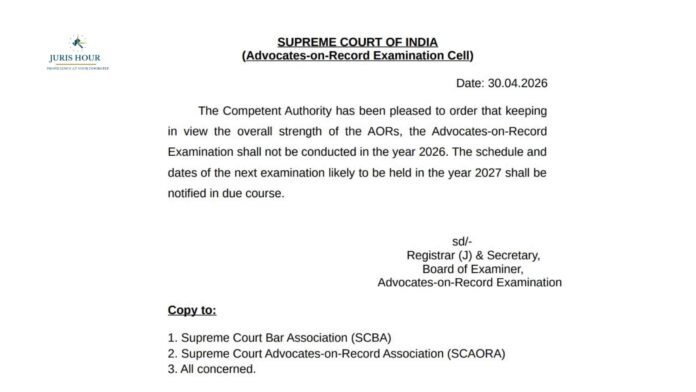
The Supreme Court of India has announced that the Advocates-on-Record (AOR) Examination will not be conducted in the year 2026. The decision has been taken by the Competent Authority of the Court, keeping in view the current overall strength of Advocates-on-Record.

As per the official communication dated April 30, 2026, issued by the Advocates-on-Record Examination Cell, the Court has assessed that the existing number of AORs is sufficient, thereby obviating the need to hold the examination this year. The AOR examination is a crucial gateway for advocates seeking the exclusive right to file and act on behalf of parties before the Supreme Court.

The notification further clarifies that the next AOR Examination is likely to be conducted in the year 2027. However, the exact schedule and dates for the examination will be notified in due course. This effectively means that aspirants will have to wait an additional year for the opportunity to qualify as Advocates-on-Record.

The communication has been formally issued under the authority of the Registrar (Judicial) and Secretary to the Board of Examiners for the AOR Examination. Copies of the notification have also been circulated to the Supreme Court Bar Association (SCBA) and the Supreme Court Advocates-on-Record Association (SCAORA), among others.

The decision is expected to have a direct impact on advocates preparing for the examination, as it alters the usual annual cycle of the AOR test. At the same time, it reflects the Court’s administrative assessment of maintaining a balanced and adequate pool of qualified Advocates-on-Record for effective functioning.

Read More: IBC Remedy Must Be Exhausted; Approach NCLAT: Supreme Court Declines Interference in CIRP Withdrawal Dispute

Mariya Paliwala
Mariya Paliwalahttps://www.jurishour.in/
Mariya is the Senior Editor at Juris Hour. She has 7+ years of experience on covering tax litigation stories from the Supreme Court, High Courts and various tribunals including CESTAT, ITAT, NCLAT, NCLT, etc. Mariya graduated from MLSU Law College, Udaipur (Raj.) with B.A.LL.B. and also holds an LL.M. She started her career as a freelance tax reporter in the leading online legal news companies.

Latest articles

JURISHOUR | TAX LAW DAILY BULLETIN : APRIL 30, 2026

Here’s the Tax Law Daily Bulletin for APRIL 30, 2026.GSTGST PENALTY NOT SPECIFIED IN...

Can HC Reassess Guideline Value Under Article 227? Supreme Court Says No, Restores ₹1,000/sq. ft. Compensation

The Supreme Court has held that a High Court cannot reassess or substitute a...

Supreme Court Acquits Father-in-Law in Dowry Cruelty Case, Cites Contradictory Dying Declarations and Lack of Evidence

The Supreme Court has set aside the conviction of a father-in-law under Section 498A...

CESTAT Allows CENVAT Credit on Rent-a-Cab & Insurance Services; No Reversal Required for Services to SEZ

The Chennai Bench of the Customs, Excise and Service Tax Appellate Tribunal (CESTAT) has...

More like this

JURISHOUR | TAX LAW DAILY BULLETIN : APRIL 30, 2026

Here’s the Tax Law Daily Bulletin for APRIL 30, 2026.GSTGST PENALTY NOT SPECIFIED IN...

Can HC Reassess Guideline Value Under Article 227? Supreme Court Says No, Restores ₹1,000/sq. ft. Compensation

The Supreme Court has held that a High Court cannot reassess or substitute a...

Supreme Court Acquits Father-in-Law in Dowry Cruelty Case, Cites Contradictory Dying Declarations and Lack of Evidence

The Supreme Court has set aside the conviction of a father-in-law under Section 498A...