
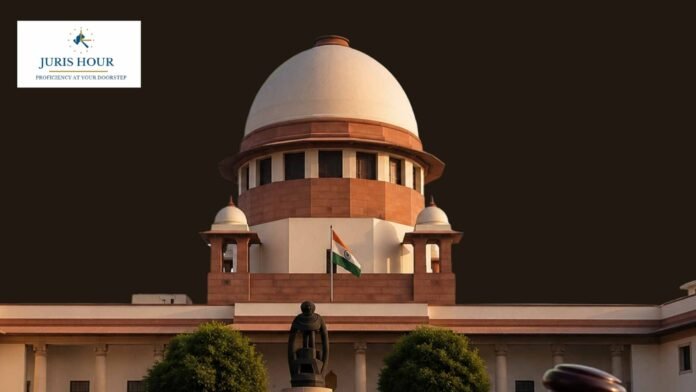
The Supreme Court has ruled that Section 98(2) of the Gujarat Prohibition Act, 1949 does not impose an absolute prohibition on the interim release of vehicles seized for allegedly transporting liquor beyond the prescribed quantity.
Setting aside orders passed by the Gujarat High Court and the courts below, the Bench of Justice Prashant Kumar Mishra and Justice Shree Chandrashekhar directed the release of a commercial truck to its owner during the pendency of the criminal trial, subject to a personal bond and security of Rs.15 lakh. Keeping seized vehicles at police stations for years serves no useful purpose and results in deterioration, loss of value and continuing financial hardship to their owners.
Buy Now: Supreme Court Judgments E-Compilation – August 2026
“A court ought not sit on seized property for years without cause,” the Supreme Court observed while emphasising that applications for interim custody must be decided expeditiously and judiciously.
The dispute arose from the seizure of an Ashok Leyland truck bearing registration number RJ-14-GQ-2269 during the intervening night of January 4 and 5, 2025.
According to the prosecution, the truck was travelling from Modasa towards Vadodara through Lunawada when it was intercepted by the police. The vehicle was allegedly transporting Indian-made foreign liquor under the guise of carrying ordinary transport goods.
The driver, identified as Qasid Mohammad Khan, told the police that the truck contained miscellaneous goods belonging to its owner, M/s ABC Express. Upon opening the rear doors, the police allegedly found plastic bags, plastic boxes and khaki-coloured cardboard boxes containing bottles of liquor.
The driver was unable to produce any pass or permit authorising the transportation of the liquor. The truck and its driver were consequently taken into police custody and the vehicle was unloaded in the presence of panch witnesses.
The authorities claimed to have recovered 8,064 bottles containing approximately 22,532.253 litres of liquor, valued at Rs.17,02,656. The truck also contained edible transport goods valued at Rs.98,66,552.
A criminal case was registered at Lunawada Police Station in Mahisagar district for alleged offences under Sections 65(a), 65(e), 98(2), 81, 116(b) and 83 of the Gujarat Prohibition Act. After completing the investigation, the police filed a chargesheet on March 1, 2025 against four accused persons, including the driver.
The truck owner filed an application before the Chief Judicial Magistrate, Lunawada, seeking interim custody of the vehicle under Section 497 of the Bharatiya Nagarik Suraksha Sanhita, 2023.
The Magistrate rejected the application on May 22, 2025. The Sessions Judge, Mahisagar, subsequently affirmed that decision on August 7, 2025.
The owner then approached the Gujarat High Court under Articles 226 and 227 of the Constitution and Section 528 of the BNSS. The High Court dismissed the petition on September 9, 2025, leading to the appeal before the Supreme Court.
Before the Supreme Court, the owner argued that the seized truck was a commercial transport vehicle and that the firm itself had not been implicated in the alleged offence.
It was submitted that the criminal trial could take four to five years to conclude, while the truck had already remained parked at the police station for a considerable period. Continued detention was causing the vehicle to deteriorate and depriving the owner of its commercial use.
The owner expressed willingness to furnish adequate security and comply with appropriate conditions for obtaining interim custody.
The Gujarat government opposed the application, arguing that Section 98(2) of the Prohibition Act prevented the release of the vehicle on bond or surety because the quantity of liquor recovered exceeded the prescribed limit.
Rejecting the State’s interpretation, the Supreme Court held that Section 98(2) is not an absolute embargo on the interim release of a seized vehicle.
The Bench relied on its 2024 decision in Khengarbhai Lakhabhai Dambhala v. State of Gujarat, in which the Court had examined the relationship between the confiscation provisions of the Gujarat Prohibition Act and the powers of criminal courts to grant interim custody of seized property.
The Court reiterated that the provisions operate in different fields. Section 98 deals with the eventual confiscation of articles and conveyances connected with an offence, whereas the provisions governing interim custody empower the jurisdictional criminal court to make appropriate arrangements for property produced during an inquiry or trial.
The Supreme Court said the lower courts had taken an unduly narrow view of their powers. The legislative purpose behind the custody and disposal provisions is to give courts broad discretion to consider the circumstances of each case and decide how seized property should be preserved pending trial.
The Bench also noted that the High Court and the subordinate courts had relied solely on Section 98(2) without examining the settled principles governing the interim custody of seized vehicles or the effect of the amendment to the provision that came into force on July 31, 2024.
Referring to its earlier ruling in Basavva Kom Dyamangouda Patil v. State of Mysore, the Supreme Court reiterated that property seized by the police should not remain in the custody of the court or police longer than absolutely necessary.
The Court explained that property may be returned to its owner during an inquiry or trial, particularly when it is subject to natural deterioration or when other compelling circumstances justify its release in the interest of justice.
Reliance was also placed on Sunderbhai Ambalal Desai v. State of Gujarat, which highlighted the widespread problem of seized vehicles remaining at police stations for prolonged periods.
The Court said applications seeking interim custody must be dealt with expeditiously while considering the owner’s interest, the risk of loss or misappropriation, the public interest in avoiding indefinite police custody and the need to preserve evidence.
Evidence may be preserved through a detailed panchnama, photographs and videography where production of the actual vehicle throughout the trial is unnecessary, it added.
The Bench further referred to General Insurance Council v. State of Andhra Pradesh, in which the Supreme Court had recognised that vehicles kept in the open at police stations rapidly lose their roadworthiness and may have valuable parts stolen or removed.
Applying these principles, the Supreme Court found that the relevant factors weighed in favour of the truck owner.
The Bench observed that continued seizure was causing a real and ongoing loss of livelihood. The vehicle was occupying space at the police station while deteriorating and losing value with each passing day.
The chargesheet had already been filed, and any remaining evidentiary value of the truck could be preserved through a panchnama, photographs and videography. A similar process had already been followed when the edible goods carried in the truck were released under earlier court orders.
The Supreme Court said courts must consider what purpose is actually served by keeping a vehicle in a state of “suspended animation” during a prolonged criminal trial.
The Court also rejected the finding that the possibility of future confiscation prevented the grant of interim custody.
It distinguished the confiscation regime under the Indian Forest Act, 1927, considered in State of Madhya Pradesh v. Uday Singh, noting that the applicable Madhya Pradesh amendment expressly excluded the jurisdiction of other courts, tribunals and authorities after initiation of confiscation proceedings.
The Bench also found that Multani Hanifbhai Kalubhai v. State of Gujarat, another decision relied upon by the High Court, arose under the Gujarat Animal Preservation Act, 1954 and did not concern confiscation.
The Gujarat Prohibition Act has its own confiscation procedure, including notice to the owner, an opportunity of hearing and an option to pay a fine in lieu of confiscation. That procedure could not prevent the court from granting interim custody of the truck, the Bench held.
Allowing the appeal, the Supreme Court directed that interim custody of the truck be handed over to its owner subject to several safeguards.
The owner must furnish a personal bond along with appropriate security of Rs.15 lakh to the satisfaction of the trial court. The owner must also undertake to produce the truck before the investigating officer or the trial court whenever directed.
The truck cannot be sold, transferred or subjected to any third-party interest during the pendency of the criminal trial.
Before releasing the vehicle, the investigating officer must prepare a detailed panchnama and record its condition through photographs and videography. This process must be conducted in the presence of the owner’s authorised representative and two independent witnesses, and the resulting material must be placed before the trial court.
If the vehicle is ultimately ordered to be confiscated, the trial court may proceed against the security furnished by the owner. It may also pass further orders, including an order for auction of the vehicle, as permitted by law.
The owner will additionally be required to comply with any further conditions imposed by the trial court to protect the prosecution and the pending proceedings.
The Supreme Court clarified that its observations were confined to the question of interim custody. They must not be treated as expressing any opinion on the merits of the criminal case, which must be decided independently.
Membership Required to Access Case Details & Order Copy
To view the complete Case Details and Download Order Copy, you must have an active membership. Please subscribe to continue.
Read More: NSE Clearing’s Committee Lacked Power To Order Restitution Of Liquidated Securities: Supreme Court

