
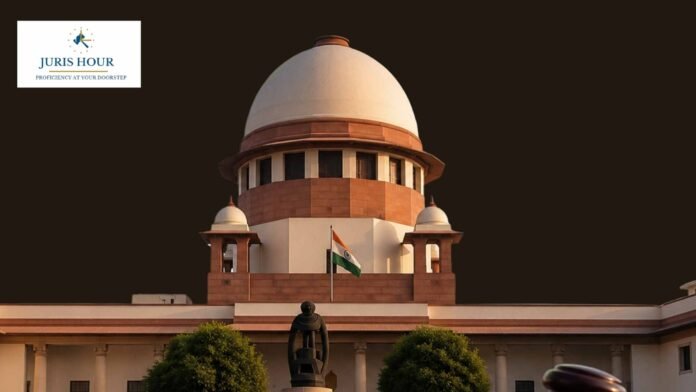
The Supreme Court has ruled that a High Court possesses inherent jurisdiction to recall its own criminal judgment when a mistake by the court results in a miscarriage of justice, including where an accused who was a juvenile on the date of the offence is denied the statutory protections available under juvenile justice law.
A Bench comprising Justice Prashant Kumar Mishra and Justice Shree Chandrashekhar held that the prohibition against altering or reviewing a signed judgment under Section 362 of the Code of Criminal Procedure cannot be interpreted in a rigid or overtechnical manner that defeats the ends of justice.
The Court observed that if a juvenile is denied a statutory benefit and thereby suffers grave prejudice, the High Court has the necessary powers under Section 482 CrPC to remedy the situation and secure justice. Section 362 CrPC cannot be applied rigidly when a court’s mistake causes grave prejudice; conviction under Section 201 IPC also requires proof that an offence was committed and evidence was destroyed to screen the offender.
Buy Now: Supreme Court Judgments E-Compilation – August 2026
The criminal case arose from the deaths of Bhuri and her infant daughter Guddi, whose bodies were found on a railway track near Sikrauda village in Madhya Pradesh’s Morena district in September 2004.
An FIR was registered on September 17, 2004, against Bhuri’s husband, parents-in-law and brothers-in-law. The prosecution alleged that Bhuri had been subjected to cruelty over dowry, murdered within seven years of her marriage, and that the accused had subsequently caused the disappearance of evidence.
According to the prosecution, Railway Gangman Badri Baghel first saw the bodies on the railway track. Although a crowd had gathered, the accused allegedly removed the bodies and cremated them without informing either the police or Bhuri’s relatives.
The accused were charged under Sections 302, 304B and 201 read with Section 34 of the IPC. During the trial, however, several prosecution witnesses, including Bhuri’s brothers and mother, did not support the allegations of dowry demand or harassment. Several other witnesses were declared hostile.
The trial court consequently acquitted the accused of murder and dowry death but convicted them under Section 201 Part II IPC for allegedly causing the disappearance of evidence. On December 21, 2005, each accused was sentenced to three years’ rigorous imprisonment and a fine of ₹1,000.
The Madhya Pradesh High Court dismissed their criminal appeal on March 17, 2017. The appellant thereafter approached the Supreme Court through a special leave petition, which was dismissed as withdrawn on May 11, 2018.
After withdrawing the special leave petition, the appellant moved the Madhya Pradesh High Court under Sections 482 and 362 CrPC, seeking recall of the judgment dismissing his criminal appeal.
He contended that he was about 17 years old when the incident occurred and that neither the trial court nor the appellate court had considered his juvenility. He claimed that he was previously unaware of the special statutory protections available to a child in conflict with law.
The appellant relied on his primary and middle-school records, which recorded his date of birth as July 1, 1987. Since the incident occurred on September 13, 2004, he maintained that he was a juvenile on the relevant date.
The High Court referred the matter to the Juvenile Justice Board, Morena, for an inquiry. In its report dated May 11, 2019, the Board accepted the school records and birth certificate and determined that the appellant was 17 years, two months and 12 days old on the date of the occurrence.
The State did not challenge the Juvenile Justice Board’s finding.
Despite the uncontroverted finding of juvenility, the High Court dismissed the recall petition. It held that although juvenility is a jurisdictional fact and may be raised at any stage, it could not reopen a conviction that had attained finality after the appellant approached the Supreme Court.
The High Court distinguished its inherent powers under Section 482 CrPC from the Supreme Court’s plenary power under Article 142 of the Constitution. It reasoned that Section 482 could not be used to review or nullify a concluded judgment, particularly after the proceedings had travelled to the Supreme Court.
The High Court further observed that the appellant had not raised the juvenility plea in his earlier special leave petition and had not obtained liberty from the Supreme Court to pursue the issue subsequently.
Setting aside that reasoning, the Supreme Court held that the High Court had acted “over cautiously” and confined itself to excessive technical restrictions.
The Bench said the High Court committed an error of record in treating the appellant’s conviction as having attained finality on merits before the Supreme Court. His special leave petition had merely been dismissed as withdrawn and had not been adjudicated on merits.
The Supreme Court noted that separate special leave petitions filed by two co-accused had been disposed of by reducing their sentences to the periods already undergone. The appellant had stated on oath that he withdrew his petition to raise the juvenility issue before the High Court.
Once the Juvenile Justice Board had found him to be a juvenile and the State had not questioned that determination, it was the High Court’s duty to decide the matter in accordance with juvenile justice law, the Court held.
The Bench emphasised that juvenile justice proceedings are fundamentally different from adult criminal trials. Courts dealing with such matters act as parens patriae and must protect the best interests of children while ensuring their rehabilitation.
Beneficial and remedial legislation concerning children must be given a purposive and expansive interpretation. Courts should not allow procedural or temporal restrictions to deprive a child of statutory protection, the judgment said.
The Supreme Court clarified that Section 362 CrPC ordinarily prohibits a criminal court from altering or reviewing its judgment after it has been signed, except to correct a clerical or arithmetical error.
However, the inherent powers historically possessed by High Courts cannot be completely extinguished by Section 362, particularly when their exercise is necessary to correct a jurisdictional error, violation of natural justice, fraud, or a mistake causing prejudice.
The Court distinguished a substantive review of a judgment from a procedural recall. A High Court may recall an order passed without jurisdiction, without giving a party an opportunity of hearing, on the basis of fraud or misrepresentation, or because of a palpable mistake of law that causes prejudice.
The Court observed that procedural rules are intended to advance justice and cannot be allowed to perpetuate a wrong. Referring to the principle recognised in A.R. Antulay v. R.S. Nayak, the Bench reiterated that a person should not suffer because of a mistake committed by a court.
“The High Court has undoubted jurisdiction to recall its own order or judgment which results in miscarriage of justice,” the Supreme Court held.
It added that where a fundamental issue capable of changing the course of the decision remains undecided, the High Court retains inherent jurisdiction to correct its judgment and do complete justice, subject to any decision already rendered by the Supreme Court on the merits.
The Supreme Court also independently examined the conviction under Section 201 Part II IPC and found it legally unsustainable.
The trial court had acquitted the appellant of murder and dowry death, and that acquittal was never challenged by the prosecution. Consequently, the prosecution had failed to establish the alleged offences under Sections 302 and 304B IPC.
The Court explained that a conviction for causing the disappearance of evidence requires a finding that an offence was committed, that the accused knew or had reason to believe that the offence had been committed, and that the accused caused evidence to disappear with the intention of screening the offender from legal punishment.
Since the prosecution had not proved the crimes of murder or dowry death and the essential ingredients necessary for invoking Section 201 Part II were not established, the appellant’s conviction was illegal, the Bench concluded.
The Supreme Court accordingly set aside the December 21, 2005 judgment convicting and sentencing the appellant. As he was already on bail, he was discharged from the liability of his bail bonds.
Before closing the proceedings, the Supreme Court expressed concern over the frequent raising of juvenility claims for the first time at an advanced stage of criminal proceedings.
According to the Court, this trend reveals a serious gap in stakeholders’ understanding and implementation of juvenile justice legislation. Investigating officers frequently focus only on bringing an alleged offender to trial, while courts may fail to properly examine the person’s age when produced before them.
In that process, the statutory mandate is overlooked and the rights of juveniles in conflict with law are violated, the Court observed.
The Bench stressed that a child should not be treated as a hardened criminal and permanently stigmatised. Children may be drawn into crime because of poverty, inequality, illiteracy, discrimination or emotional and psychological circumstances. The State’s responsibility is therefore to rehabilitate and reintegrate juveniles into society.
Calling children the nation’s greatest assets, the Supreme Court said the existing system requires further strengthening, effective monitoring of investigative processes and proper implementation of statutory protections under juvenile justice law.
The appeal was accordingly allowed, and the appellant’s conviction and sentence were set aside.
Membership Required to Access Case Details & Order Copy
To view the complete Case Details and Download Order Copy, you must have an active membership. Please subscribe to continue.

