
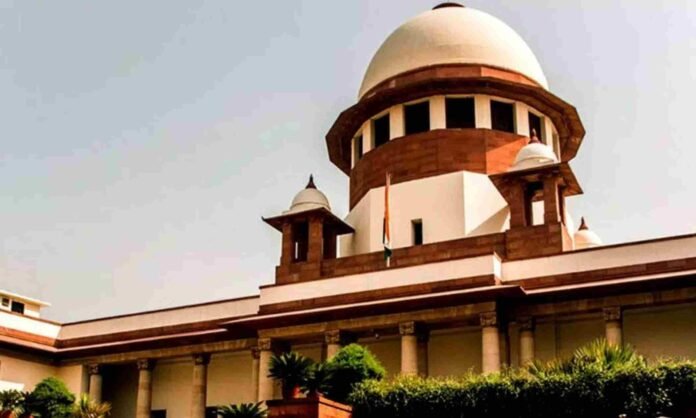
The Supreme Court has held that a surety is liable only to the extent of the loan amount originally sanctioned and cannot be made responsible for excess amounts withdrawn by the borrower without the surety’s consent. The Court set aside the Gujarat High Court’s judgment and restored the liability of the guarantors to the extent of ₹4 lakh along with applicable interest.
The bench of Justice B.V. Nagarathna and Justice Ujjal Bhuyan has observed that permitting the borrower to withdraw amounts beyond ₹4 lakh constituted a “variance” in the contract. However, this variance only affected transactions beyond the sanctioned amount. Therefore, the sureties could not be made liable for excess withdrawals, but they remained liable for the original ₹4 lakh for which they had expressly undertaken guarantee.
The dispute arose when M/s Darshak Trading Company obtained a cash-credit facility of ₹4,00,000 from Bhagyalaxmi Co-Operative Bank Ltd. on October 30, 1993. The borrower’s goods were hypothecated to the bank, and Respondent Nos. 1 and 2 stood as guarantors for the loan by executing contracts of guarantee.
According to the Bank, the borrower, allegedly in connivance with certain bank officials, withdrew amounts far exceeding the sanctioned limit of ₹4 lakh. Upon default in repayment, the Bank initiated Lavad Suit No. 181/1995 before the Board of Nominees, seeking recovery of ₹26,95,196.75 with 21% annual interest.
While the Board of Nominees decreed recovery against the principal borrower, it dismissed the claim against the sureties. On appeal, the Gujarat State Co-Operative Tribunal reversed this finding and directed the guarantors to pay ₹4 lakh with interest, restraining them from alienating their properties.
However, the Gujarat High Court, in a writ petition, set aside the Tribunal’s order. The High Court held that the guarantors could either be liable for the entire loan amount or not at all, and since the Bank had permitted excess withdrawals without their consent, they stood discharged completely under Section 139 of the Indian Contract Act, 1872.
Aggrieved, the Bank approached the Supreme Court.
The central question before the Court was whether the guarantors stood discharged entirely under Section 139 of the Indian Contract Act due to the Bank’s conduct, or whether their liability could be restricted under Section 133 to the original sanctioned amount.
The Court undertook a detailed examination of Sections 133 and 139 of the Indian Contract Act, 1872.
Section 133 provides that any variance in the terms of the contract between the principal debtor and creditor, made without the surety’s consent, discharges the surety as to transactions subsequent to the variance.
Section 139 discharges the surety if the creditor’s act or omission impairs the surety’s eventual remedy against the principal debtor.
The Bench clarified that Section 133 contemplates partial discharge — only in respect of transactions occurring after the variance. It does not mandate complete discharge in all circumstances.
Rejecting the High Court’s view that liability must be “all or nothing,” the Supreme Court held that such an interpretation was contrary to the plain language of Section 133.
On the applicability of Section 139, the Court found that although the Bank’s conduct may have affected the sureties’ rights, there was no impairment of their eventual remedy against the principal debtor. Hence, Section 139 was not attracted.
A surety cannot be bound beyond the terms of the guarantee. Discharge under Section 133 is not absolute but limited to transactions subsequent to the contractual variance. Liability of a surety is co-extensive with that of the principal debtor, but only within the bounds of the original guarantee. The High Court erred in holding that guarantors must either be liable for the entire amount or not at all.
The Supreme Court set aside the Gujarat High Court’s judgment dated June 25, 2008. The Court held that the sureties are liable to the extent of ₹4,00,000 along with applicable interest, being the originally sanctioned amount, but not for the excess amounts withdrawn thereafter.
Case Details
Case Title: Bhagyalaxmi Co-Operative Bank Ltd. v. Babaldas Amtharam Patel (D)
Citation: JURISHOUR-153-SC-2026
Case No.: Civil Appeal No. 3200 of 2016
Date: February 27, 2026

