
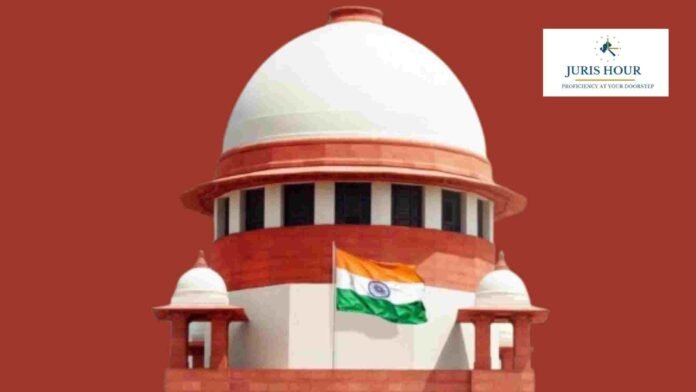
The Supreme Court of India has dismissed a Special Leave Petition challenging the authority of a State Anti-Corruption Bureau (ACB) to investigate corruption cases against Central Government employees.
The bench of Justice J.B. Pardiwala and Justice Satish Chandra Sharma observed that state police agencies are legally empowered to register and investigate offences under the Prevention of Corruption Act, 1988, even when the accused is a Central Government servant, provided the offence is committed within the State’s territorial jurisdiction.
The petition arose from a challenge to a Rajasthan High Court order dated 3 October 2025, which had upheld the jurisdiction of the Rajasthan Anti-Corruption Bureau to investigate and file a charge-sheet against a Central Government employee without prior approval or consent of the Central Bureau of Investigation (CBI).
Before the Supreme Court, the petitioner contended that offences under the Prevention of Corruption Act involving Central Government employees could be investigated only by the CBI under the Delhi Special Police Establishment (DSPE) Act, 1946, and that State ACBs lacked jurisdiction in the absence of CBI consent. Two key legal questions were framed: whether a State ACB could register and investigate a corruption case against a Central Government employee, and whether a charge-sheet filed by the ACB without CBI approval could be considered valid in law.
Rejecting the petitioner’s arguments, the Supreme Court held that the High Court had correctly answered both questions against the accused. The Bench observed that the Prevention of Corruption Act does not create an exclusive investigative domain in favour of the CBI. Instead, it permits investigation by any competent police agency, subject to the rank requirements prescribed under Section 17 of the Act.
The Court traced the statutory framework governing criminal investigations, emphasising that the Code of Criminal Procedure (CrPC) is the parent legislation for investigation, inquiry, and trial of offences. Under Section 156 of the CrPC, any officer in charge of a police station may investigate a cognizable offence within his jurisdiction without requiring a magistrate’s order. The Court reiterated that unless a special statute expressly or impliedly excludes the application of the CrPC, its provisions continue to apply.
Examining the Prevention of Corruption Act, the Bench noted that while it is a special statute dealing with bribery and corruption, it does not prescribe a separate or exclusive investigative mechanism. Section 17 of the Act merely stipulates the minimum rank of the police officer authorised to investigate such offences and does not bar State police agencies from conducting investigations against Central Government employees.
The Supreme Court further explained the role of the CBI under the DSPE Act, clarifying that the Act is permissive and enabling in nature. It empowers the CBI to investigate specified offences but does not divest State police forces of their concurrent jurisdiction under general criminal law. The Court highlighted that the investigative roles of the CBI and State police are supplementary rather than mutually exclusive.
In support of its reasoning, the Bench relied on earlier precedents, including the landmark 1973 judgment in A.C. Sharma v. Delhi Administration, where the Supreme Court had held that the DSPE Act does not exclude the jurisdiction of regular police authorities to investigate corruption offences against Central Government employees. The Court also approved similar views taken by the High Courts of Madhya Pradesh, Andhra Pradesh, and Kerala on the issue.
Concluding that there was no error of law in the High Court’s judgment, the Supreme Court dismissed the Special Leave Petition and upheld the validity of the investigation and charge-sheet filed by the Rajasthan Anti-Corruption Bureau. All pending applications were also disposed of.
Case Details
Case Title: Nawal Kishore Meena Versus State Of Rajasthan
Case No.: Petition for Special Leave to Appeal (Crl.) No.492/2026
Date: 19-01-2026
Counsel For Petitioner: Dr. Manish Aggarwal
Counsel For Respondent: Shivmangal Sharma, AAG

