
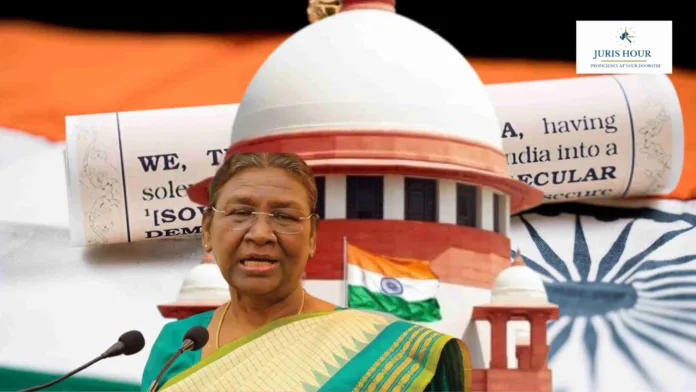
In a significant constitutional development, President Droupadi Murmu has invoked her powers under Article 143(1) of the Constitution to refer a set of 14 critical legal questions to the Supreme Court for its advisory opinion.
As per Article 143(1) of the Constitution the Supreme Court can issue any order or decision needed to ensure complete justice in any case before it. These decisions will be valid and enforceable across India, in a way defined by a law made by Parliament. Until such a law is made, the President can decide how they will be enforced.
The move comes in the wake of the apex court’s landmark April 8 judgment, which introduced the concept of “deemed assent” for Bills pending with Governors — a notion the President has stated is “alien to the constitutional scheme.”
In her letter to the Court, President Murmu highlighted that Articles 200 and 201 of the Constitution — which govern the assent process for state legislation by Governors and the President respectively — do not prescribe any time frame for decision-making. She asserted that the Supreme Court’s recent ruling effectively circumscribes the discretionary powers vested in the offices of the President and Governors, thereby raising fundamental constitutional concerns.
The 14 questions referred by the President cover a broad spectrum of constitutional interpretation related to federal structure, separation of powers, and the limits of judicial review. They aim to seek clarity on the interplay between the executive’s discretion and judicial oversight in the legislative process.
The questions referred to the Supreme Court are:
- Governor’s Options on Bills: What constitutional avenues are available to a Governor when a Bill is presented under Article 200?
- Binding Nature of Cabinet Advice: Is the Governor obliged to follow the advice of the Council of Ministers in exercising options under Article 200?
- Judicial Review of Governor’s Discretion: Is the Governor’s constitutional discretion under Article 200 subject to judicial review?
- Scope of Article 361: Does Article 361 provide an absolute bar on judicial scrutiny of the Governor’s actions under Article 200?
- Judicially Imposed Timelines: In the absence of constitutional timelines, can the courts impose deadlines or prescribe procedures for Governors acting under Article 200?
- Presidential Discretion Under Article 201: Is the President’s discretion under Article 201 also subject to judicial review?
- Timelines for Presidential Action: Can courts mandate timelines or procedures for the President’s decisions under Article 201?
- Mandatory SC Reference in Reserved Bills: Must the President seek the Supreme Court’s opinion under Article 143 when a Bill is reserved for assent?
- Justiciability Before Enactment: Are the decisions of the Governor or President under Articles 200 and 201 subject to judicial review before a Bill becomes law? Can courts examine the contents of a Bill before it is enacted?
- Substitution Under Article 142: Can the powers or orders of the President or Governor be overridden or substituted under Article 142?
- Validity of State Laws Without Assent: Is a state law valid if the Governor’s assent under Article 200 is not granted?
- Constitution Bench Mandate: In light of Article 145(3), is it mandatory for any Supreme Court bench to refer questions involving constitutional interpretation to a five-judge bench?
- Scope of Article 142 Powers: Are the Supreme Court’s powers under Article 142 limited to procedural matters, or can they extend to orders that contradict existing laws or constitutional provisions?
- Jurisdiction Under Article 131: Does the Constitution bar the Supreme Court from adjudicating Union-State disputes except through a suit under Article 131?
This presidential reference is being closely watched by legal experts, constitutional scholars, and political leaders alike, as it touches the core of India’s federal architecture and raises critical questions about the balance of power among the executive, legislature, and judiciary.
The Supreme Court is expected to constitute a Constitution Bench to consider the reference. The outcome could have far-reaching implications for the governance process, particularly in cases of legislative deadlock between state governments and Raj Bhavans.

