
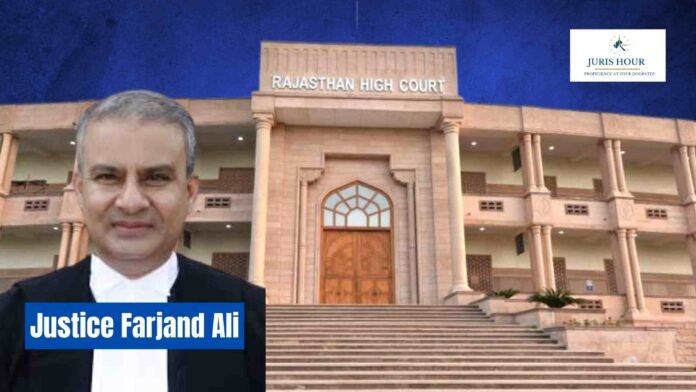
The Rajasthan High Court has strongly condemned the practice of police publicly parading accused persons, circulating their photographs on social media, and subjecting them to what the Court termed a “media trial,” holding that such conduct violates the constitutional guarantees of dignity, privacy, and fair trial under Articles 14, 21, and 22 of the Constitution of India.
The bench of Justice Farjand Ali observed that the police cannot arrogate to themselves the powers of the judiciary by portraying accused persons as guilty before trial. The Court emphasized that punishment can follow only after conviction and not at the stage of investigation or arrest.
The writ petition was filed by multiple petitioners from Jaisalmer alleging that after their arrest in connection with FIR relating to a protest incident, they were forced into humiliating conditions, photographed and videographed by police personnel, and their images were circulated on official social media platforms. The petitioners contended that such acts amounted to “social trial,” damaging their dignity and reputation while prejudicing their right to fair trial.
The High Court noted that the allegations disclosed a disturbing and increasingly routine practice wherein arrested individuals are made to sit outside police stations, photographed, and publicly displayed through newspapers and social media. The Court also referred to allegations that in some cases accused persons were compelled to remain in undergarments while photographs were taken and circulated publicly.
Justice Farjand Ali observed that an accused remains merely an accused and not a convict, and that the constitutional presumption of innocence continues unless guilt is established through a fair trial. The Court stated that publicly parading accused persons strikes at the “very root of constitutional morality and rule of law.”
The Court made strong observations on Article 21 protections, holding that the right to dignity does not evaporate upon arrest. It stated that forcing arrested individuals to sit in degrading conditions, partially disrobing them, photographing them, and circulating those images amounts to “institutional humiliation” and a direct assault on human dignity.
The judgment highlighted the irreversible impact of digital circulation of such images, particularly on women and unmarried girls, observing that even eventual acquittal cannot erase the social stigma caused by such public exposure. The Court remarked that the Constitution does not permit such irreversible injury at the hands of the State.
The Court further held that neither the CrPC, BNSS, Police Act, nor any statutory framework authorizes police officials to publicly humiliate accused persons or circulate their photographs. It described such actions as “prima facie arbitrary, illegal, and reflective of unbridled caprice.”
Discussing the doctrine of constitutional morality and separation of powers, the Court observed that the police, as part of the Executive, are duty-bound only to investigate offences and maintain law and order. Determination of guilt remains the exclusive domain of the judiciary. Any attempt by police to portray accused persons as criminals before trial amounts to encroachment upon judicial functions and undermines due process.
The High Court strongly criticized the growing trend of “perp walks,” public displays, and circulation of accused persons’ images by police departments on social media platforms. It observed that such conduct effectively imposes punishment before conviction and violates the foundational principles of criminal jurisprudence.
The Court also elaborated upon the phenomenon of “media trial by police,” describing it as a State-engineered narrative wherein investigating agencies create public perception of guilt through press conferences, disclosures, and circulation of photographs even before the judicial process unfolds.
Referring to the psychological impact of such practices, the Court observed that humiliation through public circulation of arrest-related images leaves permanent scars on the psyche and reputation of individuals. In a philosophical reference to the “Ship of Theseus” paradox, the Court remarked that a person subjected to such degradation “does not remain the same thereafter.”
The Court relied upon several Supreme Court judgments including D.K. Basu v. State of West Bengal, Mehmood Nayyar Azam v. State of Chhattisgarh, Sunil Batra v. Delhi Administration, and Umesh Kumar v. State of Andhra Pradesh to reiterate that dignity, reputation, and protection from degrading treatment are intrinsic facets of Article 21.
During the proceedings, the Rajasthan Police authorities informed the Court that all photographs and related content had been removed from social media platforms pursuant to earlier interim directions issued by the Court. The Superintendent of Police, Jaisalmer also stated that SOPs and directions had been circulated to ensure dignified treatment of accused persons and prohibit uploading of such material online.
The Court took note of a Standard Operating Procedure issued by the Additional Director General of Police, Rajasthan on 21 January 2026, directing police officers not to publicly humiliate accused persons and prohibiting uploading or sharing photographs and videos of arrested individuals on social media, police platforms, or through media channels.
Concluding the matter, the High Court reiterated that the power to investigate does not include the power to declare guilt, and warned that parallel narratives constructed outside courtrooms cannot be permitted to subvert the criminal justice system.
Case Details
Case Title: Islam Khan Versus State Of Rajasthan
Citation: JURISHOUR-1157-HC-2026(RAJ)
Case No.: S.B. Criminal Writ Petition No. 224/2026
Date: 05/05/2026
Counsel For Petitioner: Rajjak Khan
Counsel For Respondent: Deepak Chaudhary, AAG

