
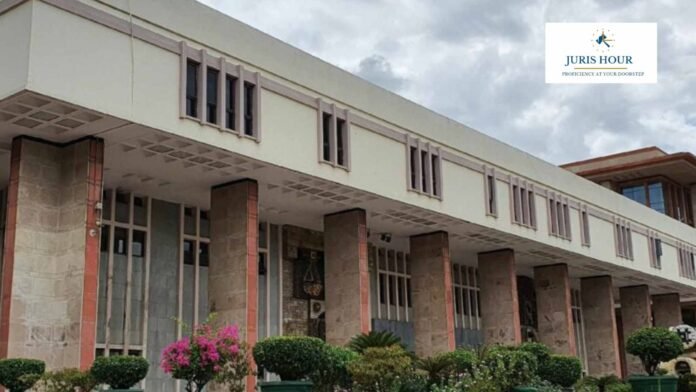
The Delhi High Court has refused to grant interim relief to the Delhi High Court Bar Association (DHCBA), the Asian Patent Attorneys Association (APAA), and the International Trademark Association (INTA), declining their request to restrain a committee constituted by the Full Court from placing its report on enhancement of the pecuniary jurisdiction of Delhi’s District Courts before the Full Court.
The Bench of Justice Anil Kshetrapal and Justice Tejas Karia held that the committee’s report is merely consultative in nature and does not have any legal effect on the existing jurisdiction of courts.
The Bench emphasized that only Parliament has the legislative competence to amend the Delhi High Court Act, 1966, and any recommendation made by the High Court cannot alter the statutory pecuniary limits.
Buy Now: GST Judgements E-Compilation – June 2026
The litigation arose from a representation submitted by the Coordination Committee of All District Courts Bar Associations of Delhi to the Union Law Minister seeking enhancement of the pecuniary jurisdiction of District Courts. A copy of the representation was also marked to the Chief Justice of the Delhi High Court.
Subsequently, during a Full Court meeting held on 2 September 2025, the judges resolved to constitute a committee comprising seven senior-most judges to examine the proposal, interact with stakeholders, and submit its recommendations. The committee thereafter invited views from various stakeholders, including the DHCBA, which participated in consultative meetings and submitted its suggestions.
The petitioners sought an interim stay on the presentation of the committee’s report before the Full Court and requested that the report be supplied to them beforehand.
Among their principal arguments were the Full Court lacked jurisdiction to constitute the committee because the original representation had not been addressed to the Chief Justice. Parliament alone could amend the Delhi High Court Act, making the committee exercise unnecessary. The Delhi High Court Bar Association ought to have been included as a member of the committee. The report should have been disclosed to stakeholders before being considered by the Full Court. Failure to furnish the report violated principles of natural justice.
If recommendations were forwarded to the Government, the petitioners would lose an opportunity to challenge the proposed amendment at an appropriate stage.
Rejecting these submissions at the interim stage, the Bench observed that the Full Court was fully competent to examine issues concerning the administration of justice merely because a copy of the representation had been forwarded to the Chief Justice.
The Court noted that constitutional institutions are entitled to deliberate upon matters affecting judicial administration and constitute internal committees to examine such issues. The committee neither exercised legislative powers nor attempted to amend the law; it merely undertook a consultative exercise and prepared recommendations for consideration by the Full Court.
A significant aspect of the ruling is the Court’s reiteration that the Delhi High Court Act, 1966 can be amended only by Parliament.
The Bench clarified that even if the Full Court ultimately forwards its recommendations to the competent authority, such recommendations would have no binding legal effect and cannot modify the jurisdiction of either the High Court or District Courts.
The Court held that recommendations made by a constitutional institution merely facilitate informed legislative decision-making and do not amount to law-making.
The Court also rejected allegations that stakeholders were denied participation.
The record showed that the committee had invited representatives of the DHCBA to attend meetings held on 27 January 2026 and 18 May 2026, while written representations from various stakeholders were also considered.
Since the petitioners had been afforded an adequate opportunity to present their views, the Court found no prima facie violation of natural justice merely because the committee’s report had not been supplied before its placement before the Full Court.
Addressing the demand for disclosure of the report, the Bench observed that the document was intended only to assist the Full Court in deciding whether any recommendation should be made to the competent authority.
At this stage, no enforceable legal rights of the petitioners were affected by non-disclosure of the report. The Court therefore declined to direct its circulation prior to consideration by the Full Court.
While examining the broader context, the Court observed that Delhi has undergone substantial demographic and economic growth since the enactment of the Delhi High Court Act in 1966.
The Bench noted that soaring property values mean that disputes involving even modest residential properties frequently exceed the existing pecuniary threshold of ₹2 crore, compelling litigants from across Delhi to institute civil suits before the High Court instead of District Courts.
The Court further observed that Delhi now has 11 judicial districts with substantial judicial infrastructure, making it appropriate for Parliament to consider whether prevailing circumstances warrant revisiting the existing pecuniary limits.
However, the Bench clarified that determining whether such revision should actually occur remains exclusively within Parliament’s domain.
Applying the settled principles governing interim injunctions, the Court held that the petitioners had failed to establish a prima facie case, balance of convenience in their favour, or likelihood of irreparable injury.
The Court refused to restrain submission of the committee’s report before the Full Court and dismissed all three interim applications. The connected writ petitions have been listed for further hearing on July 24, 2026.
Membership Required to Access Case Details & Order Copy
To view the complete Case Details and Download Order Copy, you must have an active membership. Please subscribe to continue.
Read More: New ITR Business Code 21011 Introduced for Share Traders

