
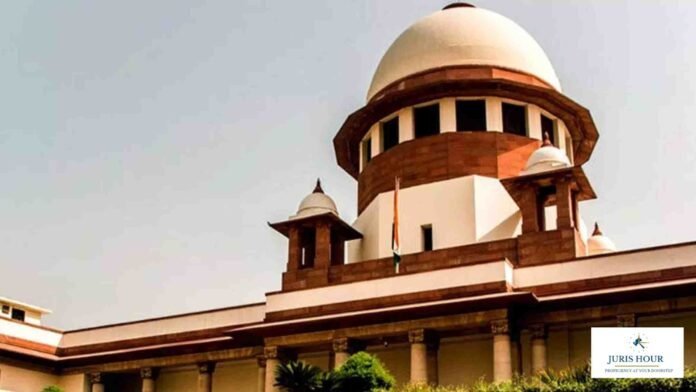
The Supreme Court has held that mere non-disclosure of examination marks or non-production of recruitment records cannot automatically lead to a presumption that candidates had qualified in the selection process.
The bench of Justice Pamidighantam Sri Narasimha and Justice Alok Aradhe while setting aside the Calcutta High Court and Central Administrative Tribunal (CAT) orders directing appointment of candidates in a recruitment dispute involving the Durgapur Steel Plant, the Court reiterated that inclusion in a select process does not create an indefeasible right to appointment.
In the case of the Supreme Court of India, the Bench comprising Justice Pamidighantam Sri Narasimha and Justice Alok Aradhe delivered the judgment in Durgapur Steel Plant & Ors. v. Bidhan Chandra Chowdhury & Ors. on May 7, 2026.
The dispute arose from a recruitment advertisement issued on October 16, 2007 by the Steel Authority of India Limited for appointment to the post of Plant Attendant-cum-Junior Technician at Durgapur Steel Plant. Initially, 90 posts were advertised, which were later increased to 200 due to additional requirements. Around 52,000 applications were received and 29,459 candidates appeared in the written examination conducted on March 23, 2008 through an independent agency.
The Supreme Court noted that after the written examination, 1,530 candidates qualified and their names were published on the website. Subsequently, appointment letters were issued to selected candidates and ultimately 194 candidates joined service.
The respondents had challenged the recruitment process alleging lack of transparency, non-disclosure of marks, and failure to reveal cut-off criteria. The matter was eventually transferred to the Central Administrative Tribunal, which in 2018 directed the authorities to offer appointments to the respondents with prospective benefits and age relaxation. The Calcutta High Court later upheld the CAT order.
Before the Supreme Court, the employer argued that neither the recruitment rules nor the advertisement required publication of marks of all candidates. It was also contended that the written examination had been outsourced to an independent agency and there was no obligation to preserve records indefinitely.
On the other hand, the respondent argued that the recruitment process was arbitrary and violative of Article 14 of the Constitution because no evaluation criteria, cut-off marks, or methodology had been disclosed. It was further contended that destruction or non-production of records warranted an adverse inference against the employer.
Rejecting the respondent’s contentions, the Supreme Court observed that the respondents had failed to establish that they had actually qualified in the written examination. The Court held that merely because candidates were not specifically shown to have failed, no inference could be drawn that they had passed the examination.
The Court further observed that neither the recruitment rules nor the advertisement prescribed any duration for preservation of recruitment records. Therefore, the explanation furnished by the employer regarding destruction or unavailability of records appeared bona fide. The Court ruled that mere non-production of such records could not justify an inference that the respondents had cleared the written examination.
Importantly, the Supreme Court also noted that in their original writ petitions, the respondents had only sought disclosure of results and had not specifically sought appointment to the post. Additionally, the qualifications for the post of Plant Attendant had been revised in 2008, making appointment at this stage impracticable.
Accordingly, the Supreme Court set aside the orders of the CAT and the Calcutta High Court directing appointment of the respondents. However, considering that one respondent had pursued the litigation continuously since 2008, the Court directed Durgapur Steel Plant to pay compensation of ₹5 lakh to him within two months.
Case Details
Case Title: Durgapur Steel Plant & Ors. Versus Bidhan Chandra Chowdhury & Ors.
Citation: JURISHOUR-1151-SC-2026
Case No.: SLP (CIVIL) NO. 41 OF 2020
Date: 07/05/2026
Read More: GST Proceedings on Corporate Guarantees Given Without Consideration Quashes: Bombay High Court

