
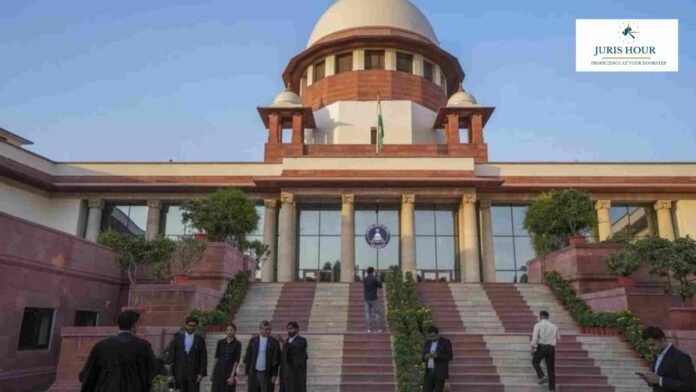
The Supreme Court has upheld the conviction of a man accused of murder in a 1998 stabbing case from Ahmedabad, reiterating that a truthful oral dying declaration and the testimony of a reliable solitary witness are sufficient to sustain conviction in a criminal trial.
The bench of Justice Aravind Kumar and Justice Prasanna B. Varale dismissed the criminal appeal filed by Mitesh @ T.V. Vaghela against the judgment of the Gujarat High Court, which had earlier affirmed his conviction under Section 302 of the Indian Penal Code and Section 135 of the Bombay Police Act.
The Trial Court had sentenced the accused to life imprisonment along with fine for the offence of murder.
As per the prosecution case, the deceased Somabhai Rabari was running a tea stall in Ahmedabad. On the night of 11 December 1998, a quarrel allegedly took place between the deceased and the accused after the accused threw a half-burnt cigarette into a bucket used for washing tea cups and saucers. The deceased reportedly informed his brother about the altercation and stated that the accused had threatened him.
The following morning, the deceased was found lying in an injured condition near his tea stall with multiple stab injuries. According to the complainant, who was also the deceased’s brother, the injured man disclosed that the accused had attacked him. The deceased allegedly repeated the accusation while being taken to hospital in an auto-rickshaw. However, upon arrival at the hospital, he was declared dead.
During the investigation, the police recovered the alleged weapon of offence — a knife — pursuant to information furnished by the accused. After trial, the Sessions Court convicted the accused, and the Gujarat High Court later dismissed his appeal.
Before the Supreme Court, the accused argued that the prosecution case was unreliable because several witnesses had turned hostile and the alleged oral dying declaration could not be trusted. It was contended that the deceased had sustained serious injuries and would not have been physically capable of making any statement identifying the assailant. The defence also pointed to alleged inconsistencies in the medical evidence and procedural lapses during investigation.
Rejecting these submissions, the Supreme Court independently re-appreciated the evidence and held that the prosecution had successfully established the guilt of the accused beyond reasonable doubt.
The Court observed that the testimony of the complainant regarding the oral dying declaration remained unshaken during cross-examination. The Bench noted that the deceased had named the accused immediately after the incident and repeated the allegation several times while being transported to the hospital.
The Supreme Court also upheld the reasoning of the Gujarat High Court that merely because the deceased later became unconscious at the hospital, it could not be presumed that he was unconscious immediately after the attack when his brother reached the spot. The Court further noted that no suggestion had been put to the doctors regarding the precise duration for which the deceased could have remained conscious after sustaining injuries.
Apart from the oral dying declaration, the Court placed significant reliance on the testimony of an independent rickshaw driver who claimed to have witnessed the assault. The witness deposed that he had seen the accused inflict a knife blow on the deceased during a quarrel near the tea stall and thereafter flee from the spot with the weapon. The Bench found the testimony to be “cogent, complete and of sterling quality”.
The Court held that the evidence of the complainant and the eyewitness, when read together with surrounding circumstances, conclusively established the prosecution case.
Importantly, the Supreme Court reiterated the settled legal principle that conviction can be based on the testimony of a solitary witness if the evidence is trustworthy and reliable. Referring to earlier precedents, the Court observed that Indian criminal jurisprudence emphasizes the quality of evidence rather than the number of witnesses examined.
While dismissing the appeal, the Court granted liberty to the appellant to seek remission in accordance with the applicable policy, considering that he had already undergone a substantial period of imprisonment.
Case Details
Case Title: Mitesh @ T.V. Vaghela Versus The State Of Gujarat
Citation: JURISHOUR-1204-SC-2026
Case No.: Criminal Appeal No. 212/2012
Date: 11/05/2026

