
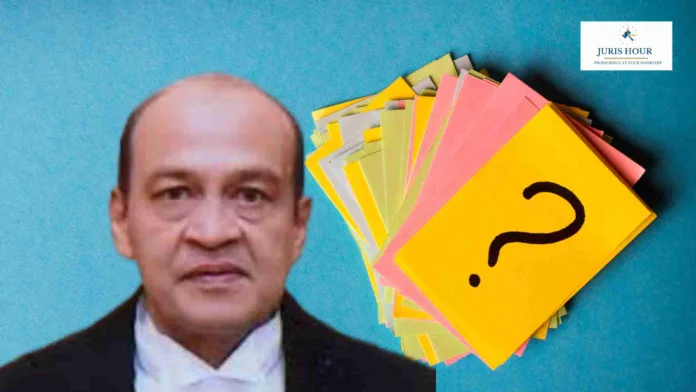
Justice Yashwant Varma of the Allahabad High Court is facing possible impeachment in the upcoming Monsoon session of Parliament, following serious corruption allegations stemming from a fire incident at his Delhi residence earlier this year.
Justice Varma’s only viable escape from the impending removal proceedings may be to tender his resignation. If he steps down, he would retain post-retirement benefits. However, a successful motion for removal passed by Parliament would strip him of all pension and retirement entitlements.
The controversy erupted after a fire in March at Justice Varma’s Delhi residence led to the discovery of multiple burnt sacks containing large amounts of unaccounted cash in the outhouse. Although the judge denied any knowledge of the money, a Supreme Court-appointed in-house inquiry led by then Chief Justice of India, Sanjiv Khanna, found him responsible after recording testimonies, including Varma’s own.
Acting on the panel’s report, Justice Khanna formally urged the President and Prime Minister to initiate Justice Varma’s removal.
Under Article 217 of the Constitution, a High Court judge may resign by submitting a written notice to the President. The resignation takes effect immediately and does not require formal acceptance. However, if Parliament removes a judge, they forfeit all post-retirement benefits.
To initiate removal, a motion must be supported by at least 50 members of the Rajya Sabha or 100 members of the Lok Sabha. Once admitted, the Judges (Inquiry) Act, 1968, mandates the formation of a three-member inquiry panel comprising a Supreme Court judge, a High Court Chief Justice, and an eminent jurist.
However, Union Parliamentary Affairs Minister Kiren Rijiju highlighted the exceptional nature of the case, pointing out that an internal judicial inquiry has already found the judge culpable. “This is a slightly different case. The in-house committee has submitted its findings, which cannot be overlooked,” he said, adding that reconciling this with the statutory process under the Judges (Inquiry) Act will be a decision for the presiding officers of Parliament.
Vice-President Jagdeep Dhankhar, during a meeting with members of the Punjab and Haryana High Court Bar Association, also raised concerns over the lack of a criminal probe. “This is a deeply disturbing incident. The seized cash was clearly illegal and unaccounted for,” he stated, expressing dissatisfaction with judicial protocols that protect judges from criminal investigations unless top-level approval is granted.
Following the controversy, Justice Varma was transferred to the Allahabad High Court, where he currently holds no judicial responsibilities. Meanwhile, Rijiju has begun consultations with political parties to build consensus around a potential impeachment motion, which could become the first of its kind to be debated in the new Parliament building.
The Monsoon session of Parliament is scheduled to run from July 21 to August 12.
Expert Comment – Abhishek A Rastogi, Founder, Rastogi Chambers
Abhishek A Rastogi, Founder, Rastogi Chambers states that “this is a critical moment for judicial accountability. The Supreme Court’s swift action and constitutional process show that no one is above the law. It reinforces public trust.”
“India needs institutional safeguards like regular asset disclosures, independent oversight bodies, and enforceable ethical codes to ensure transparency in the judiciary.”
“Such proactive measures are essential not just to address misconduct but to strengthen the credibility and integrity of the judicial system.”

