
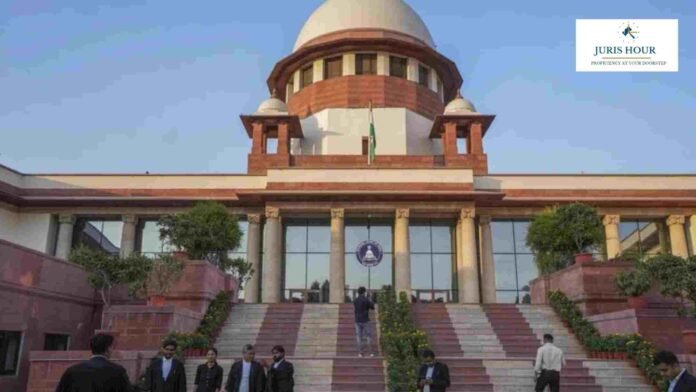
The Supreme Court has restored the dismissal of a Jharkhand Police constable accused of fraudulently securing simultaneous appointments in the police forces of Jharkhand and Bihar under different identities, holding that courts exercising judicial review cannot reappreciate evidence in departmental proceedings when findings are based on relevant material and procedural safeguards have been followed.
The bench comprising Justice Ahsanuddin Amanullah and Justice R. Mahadevan allowed the appeal filed by the State of Jharkhand and set aside the judgment of the Jharkhand High Court Division Bench which had earlier quashed the constable’s dismissal from service.
The case arose from allegations that Ranjan Kumar, appointed as a constable in Jharkhand Police in 2005, remained unauthorisedly absent from duty and during that period allegedly secured another appointment as a constable in Bihar Police under the name “Santosh Kumar” by using forged certificates and fabricated credentials.
According to the State authorities, Ranjan Kumar was granted compensatory leave from 20 December 2007 to 23 December 2007 while posted at Dhurki Police Station in Jharkhand. However, he failed to rejoin duty and allegedly joined Bihar Police on 26 December 2007 under a different identity.
The Supreme Court noted that inquiries conducted by Bihar Police authorities indicated that “Ranjan Kumar” and “Santosh Kumar” were the same person. The Court referred to official communications and enquiry reports which allegedly established that the constable had secured appointments in two police departments by adopting different names and parentage details.
A departmental proceeding was initiated against the constable in Jharkhand. Following the enquiry, the Superintendent of Police, Garhwa dismissed him from service on 20 August 2010. The appellate authority and revisional authority subsequently affirmed the dismissal.
Although the Jharkhand High Court Division Bench later interfered with the disciplinary action and held that there was no sufficient evidence to prove the allegations, the Supreme Court disagreed with that approach. The apex court observed that the Division Bench exceeded the permissible limits of judicial review by reappreciating evidence in a departmental matter.
The Court reiterated that disciplinary proceedings are governed by the principle of “preponderance of probabilities” and not by the strict standards applicable to criminal trials. It emphasised that strict technical rules of evidence under the Indian Evidence Act do not apply to departmental enquiries.
Importantly, the Supreme Court referred to a fresh enquiry conducted pursuant to its own directions during the pendency of the appeal. The Bihar Police submitted a report dated 11 April 2026 based on forensic comparison of fingerprints, biometric records and photographs. The report concluded that “Ranjan Kumar” and “Santosh Kumar” were one and the same person.
Relying upon these findings, the Court observed that the allegations went far beyond a mere case of unauthorised absence and instead disclosed a deliberate fraud upon two State police forces. The bench remarked that fraud at the threshold of entry into public service strikes at the very root of public employment.
The Court further held that a police constable is expected to maintain the highest standards of honesty, discipline and integrity, and that continuance of such an employee in service would seriously affect institutional discipline and public confidence in the police force.
While restoring the dismissal order, the Supreme Court also directed initiation of criminal proceedings. The Court observed that the allegations prima facie disclosed offences such as cheating, impersonation, forgery, use of forged documents and furnishing false information to public authorities under the Indian Penal Code or corresponding provisions of the Bharatiya Nyaya Sanhita.
Invoking its powers under Article 142 of the Constitution, the Court additionally quashed the Bihar Police appointment order issued in favour of “Santosh Kumar” dated 26 December 2007.
The Supreme Court ultimately restored the disciplinary authority’s dismissal order as affirmed by the appellate and revisional authorities and allowed the civil appeal filed by the State of Jharkhand.
Case Details
Case Title: The State Of Jharkhand & Ors. Versus Ranjan Kumar & Ors.
Citation: JURISHOUR-1182-SC-2026
Case No.: Civil Appeal No. 7364 Of 2026
Date: 08/05/2026
Read More: Mere Presence At Crime Scene Not Enough To Invoke S. 34 IPC: Supreme Court

