
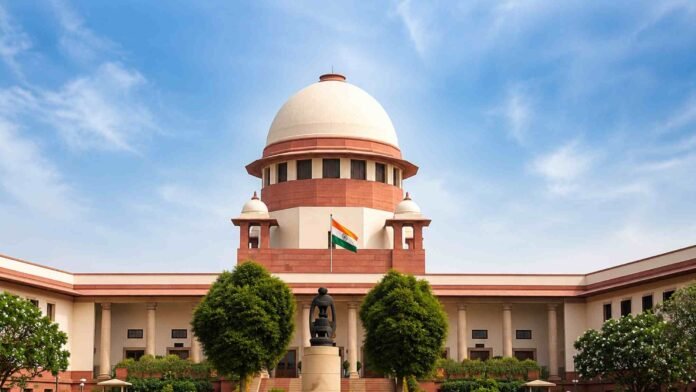
The Supreme Court has set aside an Allahabad High Court order granting bail to an accused in a case involving alleged intimidation and attempted coercion of witnesses connected with a murder trial, holding that the High Court failed to consider material evidence and overlooked an earlier Supreme Court order cancelling the same accused’s bail.
The bench of Justices Sanjay Karol and Nongmeikapam Kotiswar Singh cancelled the bail granted to accused Jeeshan and directed him to surrender before the Trial Court immediately, warning that in the event of non-compliance, coercive measures including issuance of a non-bailable warrant (NBW) should be taken.
The case arose from a series of incidents linked to an earlier murder case in Meerut in which the appellant’s brother, Aamir, was killed. According to the prosecution, some of the accused persons in that murder case had subsequently attempted to pressurize the appellant and his family members into withdrawing or compromising the criminal proceedings.
As per the record, tensions escalated on May 12, 2024, when the appellant’s uncle and cousin were allegedly intercepted by several accused persons while returning home. The FIR alleged that the accused abused and threatened them and demanded withdrawal of the murder case. Thereafter, they allegedly attacked the victims with lathis, sticks, knives and firearms, and even chased them into residential premises while continuing the assault.
The prosecution relied heavily upon CCTV footage and witness testimonies. According to the investigation, Jeeshan was allegedly seen arriving on a motorcycle, entering his house, retrieving a country-made pistol and later proceeding towards the roof of an adjoining house. Gunshot sounds were reportedly captured thereafter. Witnesses consistently stated that he fired at them with an intention to kill, though no bullet struck any victim.
Investigators further claimed that the accused admitted before the Investigating Officer that he had fired multiple rounds, later collected spent cartridges to destroy evidence, and hid the weapon after learning about police movement. Based on his disclosure, a .315 bore pistol and a live cartridge were allegedly recovered. Consequently, offences under the Arms Act were also invoked.
The litigation over bail had already witnessed multiple rounds. Initially, the accused’s anticipatory bail plea had been rejected by the High Court after observing that a prima facie case existed. However, regular bail was subsequently granted by the High Court in October 2024 on the reasoning that only a vague and general role had been assigned to him.
The Supreme Court had earlier intervened and cancelled that bail in January 2025, observing that the High Court committed a “grave error” in treating the accused’s role as vague despite the specific allegations and evidence on record.
The Court also noted troubling conduct after cancellation of bail. Following the Supreme Court’s direction to surrender immediately, the accused allegedly failed to comply and remained unavailable, leading to issuance of a non-bailable warrant and initiation of proceedings under Section 82 of the CrPC. He eventually surrendered approximately 42 days later.
While granting bail again in September 2025, the High Court had relied on factors including a seven-hour delay in lodging the FIR, absence of firearm injuries and parity with co-accused Aurangzeb.
The Supreme Court found this reasoning unsustainable.
The Court observed that although there is no absolute prohibition on granting bail after cancellation by a superior court, such relief must be based upon fresh circumstances or changed facts. It held that the High Court failed to identify any such new developments and ignored the earlier Supreme Court order altogether.
The Bench further rejected the accused’s argument that the absence of gunshot injuries weakened the prosecution’s case under Section 307 IPC.
The Court emphasized that for the offence of attempt to murder, actual injury is not always necessary if there exists evidence showing intent or knowledge that the act could result in death. It observed that if a person fires with an intention to kill and the victim escapes merely by chance, the offence can still be attracted.
Rejecting the argument of parity with co-accused persons, the Court observed that Jeeshan had been assigned a distinct role involving use of a firearm and that recovery of the pistol and ammunition further differentiated his case. The Court reiterated that parity in bail matters is not a rigid principle and cannot be mechanically applied where roles differ materially.
The Supreme Court also highlighted concerns regarding witness protection and intimidation. It observed that the present offence appeared to be part of a broader attempt to terrorise the complainant’s family, who were witnesses in the earlier murder case. Referring to previous precedents, the Court emphasized that while personal liberty remains important, courts must equally consider threats to victims and witnesses if accused persons are released.
Concluding that the High Court had ignored crucial factors including CCTV evidence, weapon recovery, prior conduct of the accused and earlier judicial findings, the Supreme Court held that the impugned order suffered from a “manifest error of law” and accordingly cancelled the bail granted to the accused.
Case Details
Case Title: Mohseen Versus The State Of Uttar Pradesh & Anr.
Citation: JURISHOUR-1344-SC-2026
Case No.: Special Leave Petition (Criminal) No.16696 Of 2025
Date: 22/05/2026
Read More: Threat To Upload Woman’s Private Bathing Video Can Amount To Criminal Intimidation: Supreme Court

