
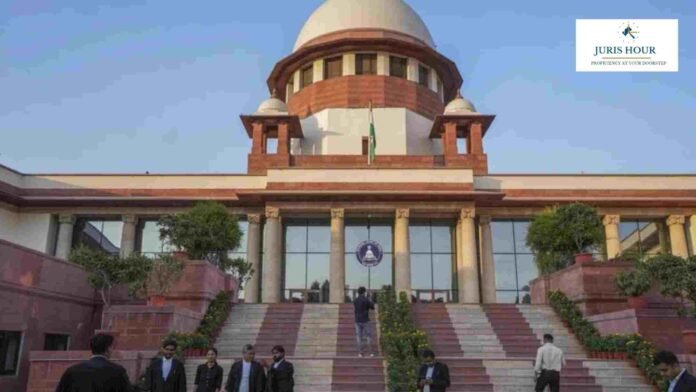
The Supreme Court of India has set aside the judgment of the Division Bench of the Delhi High Court and restored the order of the Single Judge, holding that the High Court exceeded its jurisdiction by examining the issue of title in a writ petition where such issue was neither raised nor required to be adjudicated.
The bench of Justice Vikram Nath and Justice Sandeep Mehta has observed that the writ petition was limited to the issue of incorporation of land in the layout plan and did not involve adjudication of ownership rights. Therefore, the High Court was not justified in going beyond the scope of the dispute and making observations that unsettled long-standing rights of the parties.
The case pertained to a parcel of land measuring 1600 square yards situated in Green Park Extension, New Delhi. Originally, under a 1958 layout plan, the land was reserved for a high school. However, in 1969, the reservation was removed due to insufficiency of land required for such a facility. Thereafter, the land was sold through registered sale deeds, and the purchasers remained in possession.
Disputes arose when the municipal corporation attempted to interfere with possession, leading to civil suits filed by the landowners. These suits were decreed in 1988, granting permanent injunctions against the corporation and restraining it from dispossessing the owners except in accordance with due process of law. Appeals filed by the corporation were dismissed on the ground of limitation, and the findings of the civil court attained finality.
Buy Now: E-Compilation of Supreme Court Judgements – March 2026
Years later, when the landowners sought incorporation of their plots into the layout plan, their applications were rejected by municipal authorities. The matter reached the High Court, where the Single Judge set aside the rejection and directed reconsideration of the application within a stipulated time.
However, the Division Bench reversed this decision and went further to question the title of the landowners, observing that the land had been earmarked for public purpose and that the municipal body acted as a custodian of such land. This expansion of the dispute became the central issue before the Supreme Court.
The Supreme Court held that the Division Bench committed a jurisdictional error by reopening the issue of title, which had already been settled by civil court decrees that attained finality. It observed that the municipal corporation had never seriously disputed title in earlier proceedings and could not indirectly challenge it in writ proceedings.
Rejecting the reliance placed by the corporation on entries in its property register, the Court held that such entries do not constitute proof of ownership. It further clarified that once the land was de-reserved in 1969, there was no material to suggest that it continued to retain the character of land meant for public purpose.
The Supreme Court also found the “custodian of public interest” theory adopted by the Division Bench to be unsupported by evidence and contrary to the factual matrix of the case. It noted that the issue of public purpose or title was never raised before the appropriate forums and could not be introduced at a later stage.
Accordingly, the Supreme Court set aside the Division Bench judgment and restored the order of the Single Judge. The municipal corporation has been directed to reconsider the application of the landowners for incorporation of their plots in the layout plan within 60 days by passing a reasoned order.
Case Details
Case Title: Pawan Garg & Ors. Versus South Delhi Municipal Corporation
Citation: JURISHOUR-899-SC-2026
Case No.: SLP(Civil) No(s). 26487 of 2019
Date: 20/04/2026

