
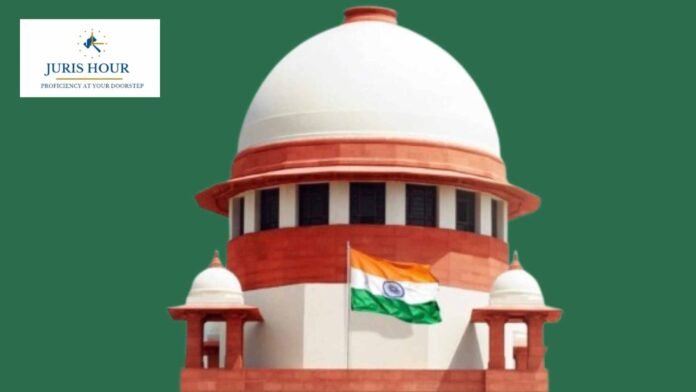
The Supreme Court has held that a litigant who remains inactive for decades cannot revive a stale claim by filing a suit for specific performance after the statutory limitation period has long expired.
Setting aside the Bombay High Court’s order, the bench of Justice Sanjay Karol and Justice Nongmeikapam Kotiswar Singh ruled that a suit instituted nearly 38 years after the alleged agreement to sell was clearly barred by limitation and amounted to an abuse of the judicial process.
The dispute concerned Plot No. 1480 at Ulhasnagar, Maharashtra, originally owned by the predecessor of the appellants. During the implementation of the Ulhasnagar Development Plan in 1974, the land was reserved for public purposes, including construction of a police station. Possession of the land was handed over to the authorities in 1988, and the original owner later sought allotment of an alternate plot under the rehabilitation scheme.
Buy Now: Supreme court Judgements E-Compilation – JUNE 2026
The respondents claimed rights over the property on the strength of an unregistered agreement to sell allegedly executed on 21 August 1984 and a subsequent power of attorney. However, the original owner consistently denied having executed any sale deed, agreement to sell, gift, mortgage or transfer in favour of any person and pursued proceedings seeking alternate land from the authorities.
Following administrative proceedings, the authorities allotted alternate land to the appellants in 2019. Although the respondents unsuccessfully challenged the allotment before the Bombay High Court, they thereafter instituted a Special Civil Suit in 2022 seeking specific performance of the alleged 1984 agreement.
The appellants moved applications under Order VII Rule 11(d) of the Code of Civil Procedure, contending that the suit was hopelessly barred by limitation under Article 54 of the Limitation Act, 1963, since it had been filed approximately 38 years after the alleged agreement.
Both the Trial Court and the Bombay High Court declined to reject the plaint at the threshold, observing that limitation required examination during trial and that the plaint did not clearly disclose that the suit was barred by law.
Allowing the appeal, the Supreme Court reiterated that Order VII Rule 11(d) CPC serves as a threshold filter enabling courts to reject suits which, on the face of the plaint itself, are barred by law.
The Court referred to its earlier decisions in Dahiben v. Arvindbhai Kalyanji Bhanusali, RBANMS Educational Institution v. B. Gunashekar, Madansuri Sri Rama Chandra Murthy v. Syed Jalal, and Mukund Bhavan Trust, emphasizing that courts must prevent sham and fictitious litigation from consuming judicial time.
The Bench observed that while considering an application under Order VII Rule 11, only the averments contained in the plaint are relevant, and if those pleadings themselves reveal that the suit is barred by limitation, the plaint must be rejected without compelling parties to undergo a full-fledged trial.
The Court noted that the respondents’ entire claim rested upon the alleged agreement dated 21 August 1984, yet there was no satisfactory explanation for why no suit for execution of the conveyance deed had been filed for more than three decades.
Referring to Article 54 of the Limitation Act, the Bench reiterated that a suit for specific performance must ordinarily be instituted within three years from the date when the right to sue first accrues. The Court held that the respondents’ attempt to initiate proceedings after nearly 38 years was plainly unsustainable.
The respondents argued that limitation should be computed from the Bombay High Court’s 2021 order, which had observed that they had not instituted any substantive civil proceedings regarding the property.
Rejecting this submission, the Supreme Court clarified that the earlier observation merely recorded the factual position that no civil suit had yet been filed. It did not create a fresh cause of action nor extend the statutory limitation period.
The Bench held that such observations could not, “by any stretch of imagination,” revive a time-barred claim.
The Court ultimately concluded that the suit was clearly barred by limitation and that permitting such litigation would defeat the very object of limitation statutes.
Making strong observations, the Bench held, “A litigant who has remained silent for decades cannot be permitted to file a suit as an afterthought, in ignorance of the laws of limitation.”
It further held that the respondents’ suit constituted an abuse of the process of the Court and therefore deserved to be rejected at the threshold itself.
The Supreme Court allowed the appeal, set aside the judgments of both the Trial Court and the Bombay High Court, and held that the suit seeking specific performance was barred by limitation under Article 54 of the Limitation Act. Consequently, the plaint was held liable to be rejected under Order VII Rule 11(d) of the Code of Civil Procedure.
Membership Required to Access Case Details & Order Copy
To view the complete Case Details and Download Order Copy, you must have an active membership. Please subscribe to continue.

