
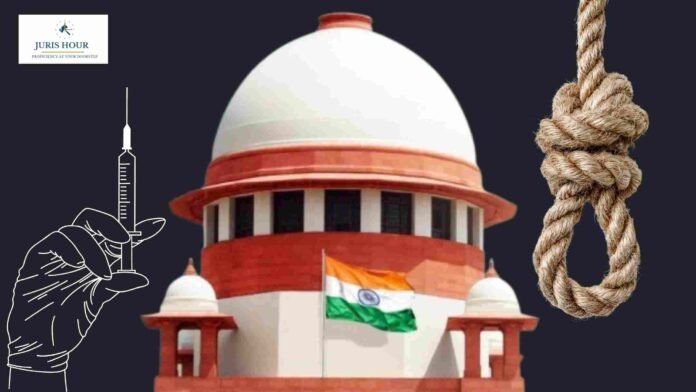
The Supreme Court asked the Union government to revisit the existing mode of executing death sentences in India, suggesting that convicts on death row could be given the option to choose between hanging and lethal injection. The court noted that methods of execution worldwide have evolved significantly since India’s colonial-era provision mandating hanging was codified.
A Bench of Justices Vikram Nath and Sandeep Mehta made the observation while hearing a petition filed by advocate Rishi Malhotra, who has challenged the constitutionality of Section 354(5) of the Code of Criminal Procedure (CrPC)— now replaced by Section 393(5) of the Bharatiya Nagarik Suraksha Sanhita (BNSS), 2023 — which mandates that every person sentenced to death “shall be hanged by the neck till he is dead.”
“It [death by hanging] is an old procedure. Several things have changed in the meantime world over. Consider what Mr. Malhotra’s suggestions are,” the Bench told senior advocate Sonia Mathur, representing the Centre, urging the government to re-evaluate the existing practice.
What is lethal injection?
Lethal injection is a method of execution used in the United States and several other countries. It involves injecting a condemned prisoner with a set of chemicals designed to cause a swift and painless death. Lethal injection is opposed by groups who argue that painful botched executions constitute cruel and unusual punishment. In many states, obtaining the chemicals required to perform lethal injection has become difficult.
Petitioner Seeks Option of Lethal Injection
Appearing before the court, Malhotra argued that even if hanging is retained as a method of execution, prisoners should be allowed to choose a more humane alternative such as lethal injection. He cited international practices, pointing out that over 40 countries have adopted lethal injection as a more dignified mode of execution.
“Death by hanging is an excruciating process, where the body may linger on the rope for several minutes or even half an hour. Lethal injection, on the other hand, is a more dignified and humane way to die,” Malhotra submitted.
His petition, filed in 2017, asserts that hanging violates Article 21 of the Constitution, which guarantees the right to life with dignity. Malhotra also relied on the 187th Law Commission Report, which had recommended replacing hanging with more humane methods such as intravenous anaesthesia, lethal injection, or even firing squad.
Centre Defends Hanging as ‘Safest and Quickest’
Responding to the court, Mathur referred to the Union government’s earlier affidavit filed in May 2023, which defended hanging as the “safest and quickest” mode of execution. The affidavit argued that hanging minimizes the risk of prolonged suffering and that lethal injection, though seemingly humane, has shown high rates of failure and complications in other countries, particularly the United States.
The government pointed out that trained medical professionals are often unwilling to participate in executions involving chemical substances due to ethical and professional concerns.
At the same time, the Centre had informed the court that it was considering the constitution of an expert committee to examine alternative, less painful methods of execution. On Wednesday, Mathur sought time to consult the Attorney General and update the court on the committee’s progress, noting that Attorney General R. Venkataramani, who is leading the case, was currently indisposed.
Accepting her request, the Bench adjourned the hearing to November 11, directing the Centre to apprise the court of any developments on the proposed review.
Court Revisits 1983 Precedent
The Supreme Court’s renewed scrutiny builds on its March 2023 observation that the 1983 judgment in Deena alias Deena Dayal v. Union of India — which upheld hanging as constitutionally valid — did not adequately apply the test of proportionality or compare empirical data on pain, suffering, and efficiency across execution methods.
In recent hearings, the Bench has shown a willingness to re-examine whether hanging aligns with the constitutional guarantee of dignity in death and whether modern science supports less painful alternatives.
Centre Warns Against Diluting Deterrence
In its previous affidavit, the government also cautioned that making executions “overtly comfortable, serene, and painless” could dilute the deterrent effect of the death penalty. It maintained that capital punishment in India is reserved for the “rarest of rare” cases involving acts of exceptional depravity or brutality.
Nevertheless, the Centre stated it was “open to reviewing” the current practice and reiterated its commitment to studying alternative methods through expert consultation.

