
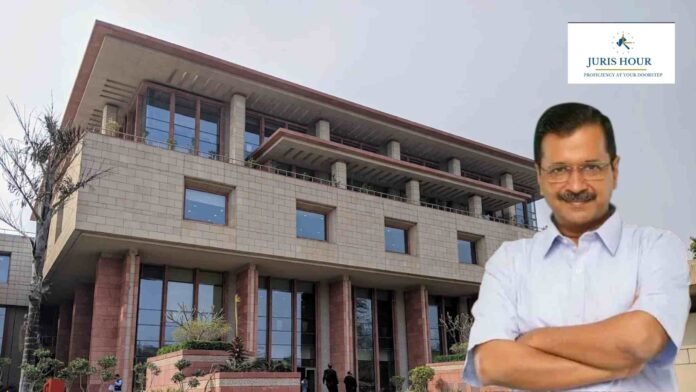
The Delhi High Court on Monday heard a petition filed by the Central Bureau of Investigation (CBI) challenging a trial court order that discharged Delhi Chief Minister Arvind Kejriwal, former Deputy CM Manish Sisodia, K. Kavitha, and 20 others in the alleged Delhi excise policy scam.
The matter came up before Justice Sharma, with Solicitor General Tushar Mehta representing the CBI, while Kejriwal appeared in person before the court.
Kejriwal Files Recusal Plea
During the hearing, Kejriwal informed the court that he had filed a recusal application, requesting that it be taken on record. He also clarified his intention to argue the case personally, stating that he had not engaged any legal counsel or filed a vakalatnama.
Responding to the development, the court sought confirmation from Kejriwal on whether he would argue the matter himself. He reiterated that he would exercise his legal right to appear in person.
The court issued notice on the recusal application and listed the matter for further hearing on April 13, 2026, at 2 p.m.
CBI Raises Objections to Recusal Requests
Appearing for the CBI, Solicitor General Mehta strongly objected to the recusal pleas, stating that repeated allegations against institutions undermine their credibility. He remarked that such claims were not new and emphasized the need to uphold the integrity of the judicial system.
Mehta also pointed out that multiple applications—seven in total—had been filed seeking the recusal of Justice Sharma. He further argued that while there was no objection to Kejriwal appearing in person, proper procedure required him to formally discharge any existing legal representation.
He cautioned against turning the courtroom into a मंच for theatrics, stressing that judicial proceedings must remain focused and disciplined.
Trial Court Had Discharged All Accused
The developments follow a significant order passed by Special Judge Jitendra Singh of the Rouse Avenue Court, who discharged all 23 accused in the case. The court held that the CBI failed to establish a prima facie case of corruption.
In a strongly worded order, the trial court observed that the chargesheet contained substantial gaps and lacked corroboration from witness statements or documentary evidence. It noted that allegations against Kejriwal were unsupported by cogent material, while no evidence was found to justify charges against Sisodia.
The court also flagged “misleading averments” in the chargesheet and highlighted inconsistencies between the claims made and the evidence presented. Taking serious note of these lapses, it ordered a departmental inquiry against the CBI’s Investigating Officer.
CBI Challenges Trial Court Findings
In its revision petition before the High Court, the CBI has termed the trial court’s decision legally unsustainable. The agency contended that the judge effectively conducted a “mini-trial” by evaluating evidence in detail at the stage of framing charges—an approach it argues is contrary to settled legal principles.
The CBI has sought reversal of the discharge order and a stay on the direction ordering an inquiry against its officer.
Background of the Case
The excise policy case has seen a series of legal developments over the past two years. Kejriwal was arrested by the CBI on June 26, 2024, from Tihar Jail, where he was already in judicial custody in a related money laundering case.
Subsequently, the Supreme Court of India granted him bail on September 13, 2024, in the corruption case linked to the excise policy. Earlier, the court had declined interim relief and issued notices on his plea challenging arrest.
Similarly, both Sisodia and Kavitha were granted bail by the apex court in connection with the same case.
Read More: GSTAT e-Filing Framework Explained: Key Forms, Digital Workflow, and Mandatory Online Access

