
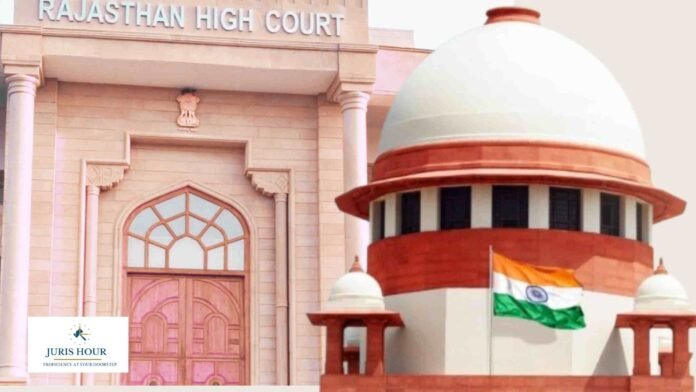
The Supreme Court has held that candidates must possess the prescribed educational qualification as on the last date of submission of application, and not at any later stage such as the examination or interview.
The bench of Justice Vikram Nath and Justice Sandeep Mehta has upheld the validity of RPSC’s press note dated November 29, 2024, which reiterated that only candidates possessing the qualification by the last date of application would be eligible. It held that the press note merely clarified the existing legal position and did not change the rules mid-process, as argued by the candidates.
The appeals were filed by the Rajasthan Public Service Commission challenging the Rajasthan High Court’s decision that had allowed certain candidates—who acquired their law degrees after applying—to participate in the selection process for the post of Assistant Prosecution Officer (APO).
The controversy arose from an advertisement dated March 7, 2024, issued by RPSC for recruitment to 181 posts of Assistant Prosecution Officer. The essential qualification required candidates to possess a professional law degree from a recognized university.
However, several candidates who were in the final year of their law course applied for the posts without having obtained their degrees as on the last date of application. Though they later acquired the qualification before the preliminary examination, RPSC disallowed their candidature, prompting them to approach the High Court.
The Rajasthan High Court ruled in favour of the candidates and directed RPSC to allow them to participate in the examination. This decision was subsequently upheld by the Division Bench, leading to appeals before the Supreme Court.
Setting aside the High Court’s ruling, the Supreme Court categorically held that the cut-off date for determining eligibility is the last date of submission of application.
The Court emphasized that the recruitment rules and advertisement must be read together, and both clearly require that a candidate must “possess” the prescribed qualification at the time of applying.
Rejecting the argument that acquiring the qualification before the examination should suffice, the Court observed that such an interpretation would introduce uncertainty and administrative complications into the recruitment process.
A crucial aspect of the ruling was the Court’s reliance on the Rajasthan Prosecution Subordinate Service Rules, 1978. It noted that an earlier provision allowing final-year candidates to apply had been deleted in 2002, thereby reflecting a clear legislative intent to disallow such candidates from participating unless they had already obtained the qualification.
The Court applied the legal maxim “what cannot be done directly cannot be permitted indirectly”, holding that candidates cannot bypass eligibility conditions by acquiring qualifications at a later stage.
The Supreme Court disagreed with the High Court’s view that, in case of ambiguity, interpretation favourable to candidates should be adopted to expand the pool of eligible applicants. It held that such an approach cannot override clear statutory requirements.
Allowing the appeals, the Supreme Court set aside the Rajasthan High Court’s judgment and upheld RPSC’s decision to reject candidates who did not possess the requisite law degree on the application date.
Case Details
Case Title: Rajasthan Public Service Commission Versus Lavanshu Sankhla & Ors.
Citation: JURISHOUR-1094-SC-2026
Case No.: Special Leave Petition (Civil) No. 32964 Of 2025
Date: 04/05/2026

