
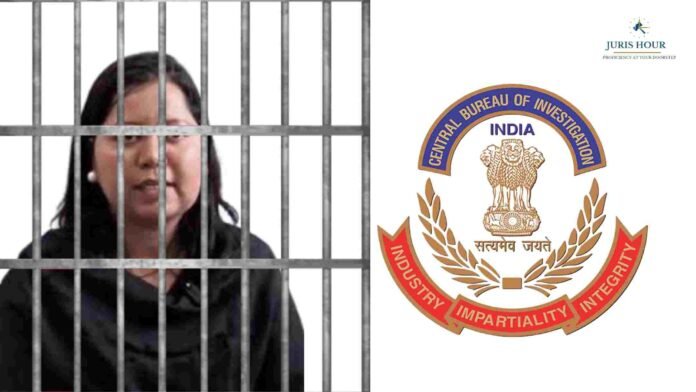
The bail application of IRS officer Prabha Bhandari is expected to be taken up for hearing today, following the completion of approximately 12 hours of remand, with arguments scheduled to commence around 12:30 PM. Legal observers indicate that the hearing may focus on whether continued custodial detention is necessary at this stage of the proceedings.
Appearing on behalf of Prabha Bhandari, Senior Advocate Purnendu Chakraborty is expected to advance detailed submissions addressing the objections raised by the prosecution. The defence may seek to persuade the court that the grounds cited for continued custody do not meet the threshold required to deny bail under settled legal principles.
The defence may submit that several aspects of the prosecution’s reply do not warrant a detailed response, as they merely reproduce material already on record. However, it is likely to be argued that certain allegations raised by the investigating agency are incorrect and misleading, and therefore deserve to be specifically denied.
The defence is also expected to place reliance on a line of judicial precedents emphasising the need for a sensitive approach while considering bail applications filed by women. It may be argued that courts have consistently recognised gender-specific considerations as a relevant factor at the stage of bail, even in serious offences.
Senior counsel may refer to a decision of the Punjab and Haryana High Court in Amanjot Kaur v. State of Punjab, where the court, while dealing with a case involving allegations of commercial quantity contraband, granted bail by treating pregnancy as a special circumstance. The defence may submit that the judgment underscores the importance of preserving dignity under Article 21 and protecting the interests of an unborn child, observing that incarceration during pregnancy can have lasting psychological consequences.
Reliance may also be placed on the Supreme Court’s ruling in Priya Taneja v. State (NCT of Delhi), where anticipatory bail was granted to a woman accused, taking into account the tender age of her infant child. The defence may argue that the decision reflects judicial recognition of caregiving responsibilities as a relevant consideration in bail matters.
The advocate is further expected to cite Satender Kumar Antil v. Central Bureau of Investigation, wherein the Supreme Court observed that courts are required to show heightened sensitivity while dealing with bail applications filed by women. It may be contended that the judgment highlights the broader social impact of incarceration on children living with incarcerated mothers, an aspect that courts are expected to take into account while balancing personal liberty against investigative interests.
Additionally, reliance may be placed on the proviso to Section 437 of the CrPC, now mirrored under Section 480 of the BNSS, which provides relaxation in granting bail to women accused. The defence may argue that this proviso has been reaffirmed by the Supreme Court in Shashi Bala @ Shashi Bala Singh v. Director of Enforcement, where the benefit of the woman-specific proviso was extended even in cases involving serious economic offences, relaxing stringent statutory conditions under special laws.
On the strength of these precedents, the defence is likely to submit that the applicant’s case merits consideration within the protective framework evolved by constitutional courts for women accused, without prejudice to the merits of the allegations.
It may be contended that the applicant has been falsely implicated, with the defence reiterating earlier submissions that there is no material to show that the applicant ever demanded, accepted, or facilitated any bribe. The advocate may point out that transcripts of the controlled call conversation do not reflect any instruction by the applicant to a co-accused to utilise alleged bribe proceeds, including for the purchase of gold, and that such allegations may be speculative in nature.
The defence is expected to argue that reliance has been placed on a controlled call made by a co-accused after being taken into custody, and that such a conversation may not meet the legal threshold required to attract offences under the Prevention of Corruption Act. It may be submitted that there is no independent evidence establishing the essential ingredients of demand or acceptance of an undue advantage by the applicant.
It could also be urged that the applicant had already marked the relevant file to other officers for further action and was not actively dealing with the matter at the time of the alleged trap proceedings. The defence may submit that during the period in question, the applicant was on leave and present at her residence, and therefore may not have been connected with the events leading to the trap.
The advocate may further argue that all recoveries relied upon by the prosecution were made from the premises of co-accused persons, and that there is no material to suggest the applicant’s knowledge of, or involvement in, such recoveries. It may be emphasised that no incriminating material was recovered from the applicant during search proceedings.
It is also likely to be argued that the prosecution’s case proceeds on assumptions that the applicant, by virtue of seniority, must have issued directions to co-accused persons, without any direct evidence supporting such a claim. The defence may submit that such presumptions cannot substitute for proof, particularly at the stage of bail.
The defence is expected to rely on the settled legal position that demand of undue advantage is a sine qua non for attracting Section 7 of the Prevention of Corruption Act, and may contend that the material placed on record does not prima facie establish this requirement.
It may be submitted that the applicant has no criminal antecedents or departmental proceedings against her, and that the absence of any incriminating recovery from her residence supports the contention that she has been falsely implicated. On these grounds, the defence may press that the bail application deserves favourable consideration.
It may be argued that the allegations against the applicant are primarily based on documents and official records, reducing the necessity of further custodial interrogation. The defence is likely to submit that since the remand period has already been availed, continued detention may not serve any meaningful investigative purpose.
The advocate may also contend that the prosecution has not demonstrated any specific or immediate apprehension of tampering with evidence or influencing witnesses. It could be argued that generalized concerns, without concrete material, may not be sufficient to justify prolonged incarceration, particularly at the bail stage.
Another ground that may be urged is the applicant’s service background and standing as a public servant, which the defence might rely upon to argue that there is no realistic risk of absconding. The court may be reminded that the applicant has fixed roots within the jurisdiction and may be willing to comply with any conditions imposed.
The defence is also expected to rely on constitutional principles, submitting that personal liberty cannot be curtailed mechanically and that bail, rather than jail, remains the norm unless exceptional circumstances are shown. It may be argued that the gravity of allegations alone cannot override the requirement of necessity for custody.
Additionally, the advocate may point out that the matter is at a stage where the investigation has progressed sufficiently, and that further detention may verge on being punitive rather than preventive. The defence could also indicate willingness to cooperate with the investigation, appear as and when required, and abide by stringent bail conditions.
The prosecution, on its part, may oppose the bail plea, reiterating concerns already placed before the court and arguing that custodial detention remains necessary. The court is expected to weigh these competing submissions during today’s hearing scheduled for 12:30 PM.
The outcome of the hearing is being closely watched, as the court’s observations may have broader implications on how remand and bail are assessed in cases involving senior government officials.

