
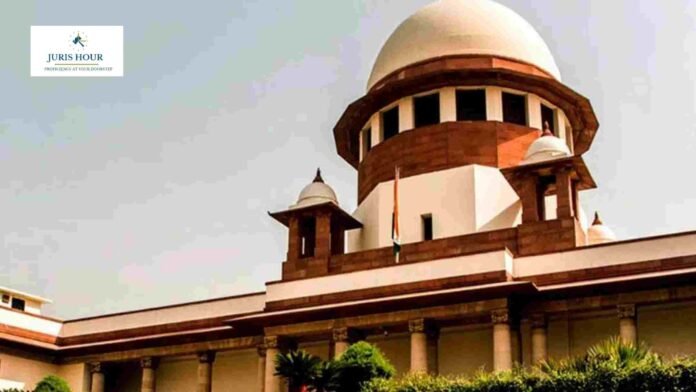
The Supreme Court has set aside an order of the Madhya Pradesh High Court which had directed a murder accused to surrender before the trial court and be granted bail on the same day and held that the acquittal of co-accused not a ground for anticipatory bail.
The bench of Justice J.B. Pardiwala and Justice Vijay Bishnoi has observed that an accused who has evaded arrest for years cannot ordinarily claim the discretionary relief of anticipatory bail, and that the subsequent acquittal of co-accused does not automatically entitle such an absconder to parity.
The appeal arose from a 2017 incident allegedly stemming from political rivalry, leading to three FIRs being registered in Madhya Pradesh. In the principal FIR, the complainant alleged that he and his companions were wrongfully restrained and attacked by a mob armed with stones, sticks, swords and firearms. Two persons suffered gunshot injuries, and one of them later succumbed, resulting in the addition of Section 302 of the IPC.
The accused in question, named in the FIR, allegedly remained absconding from the date of the incident. Police records indicated repeated attempts to trace him, proposals for proclamation proceedings, and even announcements of reward for his arrest. His first and second anticipatory bail applications were earlier rejected by the trial court and the High Court.
In 2023, the trial court acquitted all other co-accused in the main FIR, while in the cross-case arising from the same incident, the complainant and others were convicted. Relying mainly on the acquittal of co-accused, the accused filed a third anticipatory bail application. The High Court disposed of it by directing him to surrender and obtain bail the same day.
The original complainant challenged this order before the Supreme Court.
The court held that the High Court had not exercised its discretion judiciously.
The Court reiterated that anticipatory bail is an extraordinary remedy meant to protect individuals from arbitrary arrest, but it is not intended to shield those who deliberately evade the law. While acknowledging that there was no conclusive material showing a formal proclamation under Section 82 CrPC, the Bench observed that the accused’s prolonged non-cooperation and evasion were sufficient to disentitle him from pre-arrest bail.
Importantly, the Court rejected the argument that acquittal of co-accused constitutes a “change in circumstance” for granting anticipatory bail to an absconding accused. It noted that in trials of co-accused, the prosecution is not required to lead evidence against absconders, and therefore findings in such trials cannot be used by a fugitive to claim benefit.
The Bench also took into account allegations that the accused had threatened an injured eyewitness in 2019, leading to registration of a separate FIR, as well as multiple criminal antecedents.
The Court emphasised that an absconder is generally not entitled to anticipatory bail. Acquittal of co-accused does not automatically justify parity for an accused who avoided trial. Granting anticipatory bail to long-absconding persons sends a wrong message and incentivises evasion of law.
The Supreme Court directed the accused to surrender before the concerned court within four weeks. It clarified that he would be free to apply for regular bail thereafter, which must be decided independently and in accordance with law, uninfluenced by the present judgment.
Case Details
Case Title: Balmukund Singh Gautam Versus State Of MP
Case No.: SLP (CRIMINAL) NO. 15349 OF 2024
Date: 13/02/2026
Read More: Cement Decontrol from 1989 Bars EC Act Prosecution: Supreme Court

