
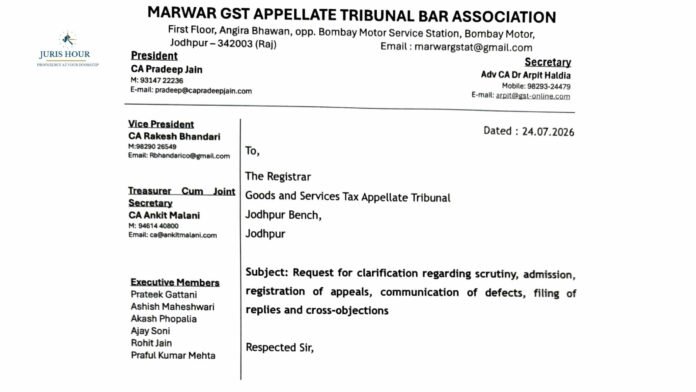
The newly constituted Marwar GST Appellate Tribunal Bar Association has written to the Registrar of the Goods and Services Tax Appellate Tribunal (GSTAT), Jodhpur Bench, seeking comprehensive procedural clarifications on several aspects of GST appeals.
The representation comes ahead of the commencement of hearings before the Jodhpur Bench from July 27, 2026, and aims to eliminate uncertainty surrounding the filing, scrutiny, registration and disposal of appeals under the GSTAT (Procedure) Rules, 2025.
Buy Now: GST Judgements E-Compilation – June 2026
Background
In its representation dated July 24, 2026, the Association welcomed the operationalisation of the GSTAT Jodhpur Bench, describing it as a significant milestone in India’s GST adjudicatory framework. The Association acknowledged the efforts of the Tribunal and Registry in making the Bench functional and initiating appellate proceedings, while pointing out that the initial phase of functioning is likely to give rise to several procedural issues requiring uniform clarification.
According to the Association, clarity at the outset would ensure consistency in practice, reduce unnecessary litigation over procedural aspects and assist taxpayers, departmental authorities and legal practitioners alike.
Six Key Procedural Issues Raised
The Bar Association has requested the Registry to issue guidance on six major procedural questions.
1. What Should Be Treated as the Date of Filing of an Appeal?
The first issue concerns the determination of the effective filing date of Form GSTAT-01 (Appeal).
Referring to Rule 19 of the GSTAT (Procedure) Rules, 2025, the Association submitted that although the Rule requires the Registrar or authorised officer to endorse the date on which an appeal is presented or deemed to have been presented, clarification is necessary on whether the date of uploading the appeal on the GSTAT portal and generation of the acknowledgement should itself be treated as the official date of filing.
The clarification assumes significance because limitation periods and other procedural timelines depend upon the date of institution of the appeal.
2. Whether Defect Removal Will Be Handled by the Registry or the Bench?
The second request relates to Rule 24, which governs scrutiny of appeals.
The Association noted that where defects are found, the Registry is empowered to return the appeal for compliance and allow time for rectification. However, uncertainty remains regarding the stage at which judicial intervention would become necessary.
It has therefore sought clarification on whether hearings relating to removal of defects will initially be conducted before the Registrar’s Court, with only unresolved matters being placed before the Judicial Bench for orders regarding registration or rejection of appeals.
3. Registration of Appeals After Admission
Another important clarification sought concerns the distinction between presentation, scrutiny, admission and registration of appeals.
The Association observed that Rule 25 provides that an appeal shall be numbered and registered upon admission. Since the Rule appears to recognise these as distinct procedural stages, it requested clarification on whether:
- separate communication will be issued after admission and registration;
- appeals will thereafter be directly listed for hearing; or
- respondents will receive formal notices after registration of the appeal.
4. Communication of Appeals, Replies and Cross-Objections
Perhaps the most significant issue raised relates to communication of appeal papers to respondents.
Referring to Rule 34, the Association pointed out that copies of appeals and supporting documents are required to be supplied to respondents and the concerned Commissioner.
However, practical questions remain unanswered, particularly in cases where appeals are filed by the Department. Taxpayers may remain unaware that an appeal has been instituted unless a formal communication mechanism exists.
The Association also highlighted that Rule 36 permits respondents to file replies within one month of receiving the appeal, while Section 112(5) of the CGST Act permits filing of cross-objections within 45 days of receipt of notice of appeal.
Accordingly, it has requested the Registry to clarify:
- how notices of appeal will be communicated;
- at what stage an appeal will be treated as admitted;
- when limitation for replies and cross-objections will commence; and
- whether respondents will receive a specific communication indicating the commencement of the statutory period for filing cross-objections.
5. Filing Additional Documents After Institution of Appeal
The Bar Association has also sought guidance regarding filing of documents after an appeal has already been instituted.
It referred to the President’s administrative instructions requiring scrutiny officers to verify whether documents such as:
- Show Cause Notice,
- Order-in-Original,
- Order-in-Appeal,
- Statement of Facts,
- Grounds of Appeal,
- proof of pre-deposit,
- court fee, and
- Vakalatnama/authorisation
have been uploaded at the time of filing.
However, the Association noted that litigants may subsequently wish to place additional records or documentary evidence before the Tribunal.
It therefore requested clarification regarding:
- the stage at which additional documents may be filed;
- whether separate applications would be required; and
- the procedure for ensuring that such documents are supplied both to the opposite party and the Bench.
6. Compliance with Rule 56 on Statutory References and Citations
The final issue concerns Rule 56 of the GSTAT (Procedure) Rules, 2025.
The Rule requires parties and authorised representatives to furnish, before commencement of proceedings, copies of law reports, statutory provisions, journals and judicial precedents proposed to be relied upon.
The Association has requested clarification on the practical mode of compliance, particularly where hearings are conducted virtually.
Among the questions raised are:
- whether compilations should be uploaded on the GSTAT portal;
- whether they should be submitted electronically through email;
- and, if email filing is contemplated, whether a designated Registry email address will be notified for such submissions.
Membership Required to Access Representation Details & Copy
To view the complete Representation Details and Download Copy, you must have an active membership. Please subscribe to continue.

