
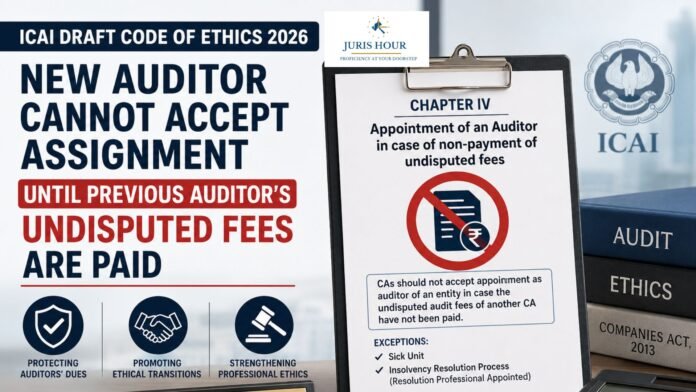
A proposed provision in the upcoming ICAI Code of Ethics 2026 has sparked significant discussion within the Chartered Accountancy profession. The draft provision seeks to prohibit Chartered Accountants from accepting an audit appointment where the undisputed audit fees of the previous auditor have not been paid by the entity.
The proposal appears under Chapter IV – Appointment of an Auditor in Case of Non-Payment of Undisputed Fees and aims to strengthen professional ethics, safeguard auditors’ legitimate dues, and discourage companies from changing auditors merely to avoid payment obligations.
What Does the Proposed Provision Say?
Under the proposed Clause 4.0, a Chartered Accountant in practice shall not accept an appointment as auditor of an entity if the undisputed audit fee payable to another Chartered Accountant for conducting a statutory audit under the Companies Act, 2013 or any other statute remains unpaid.
In simple terms, before accepting an audit assignment, the incoming auditor may need to ensure that the previous auditor’s undisputed fees have been settled by the company.
The provision defines undisputed audit fees as the audit fees reflected in accounts signed by both the auditor and the auditee, along with applicable taxes and reimbursable expenses.
Exceptions Provided
The draft provision also recognizes situations where strict application of the rule may not be practical.
Sick Units
The restriction will not apply in the case of a sick unit. This exception acknowledges the financial distress faced by such entities and ensures that statutory audits can continue despite pending audit fees.
Insolvency Resolution Cases
The restriction will also not apply where insolvency resolution proceedings have commenced and a Resolution Professional has been appointed. This carve-out aligns the ethical requirement with the realities of insolvency proceedings under India’s insolvency framework.
Objective Behind the Proposal
The proposed rule appears to be designed to:
- Protect the professional interests of auditors.
- Discourage entities from withholding legitimate audit fees.
- Promote ethical transitions between outgoing and incoming auditors.
- Enhance accountability in auditor appointments.
- Reduce instances where companies switch auditors while leaving previous audit dues unpaid.
The proposal reflects ICAI’s long-standing emphasis on professional courtesy and ethical conduct among members.
Potential Impact on Companies
If implemented, companies seeking to appoint a new auditor may first need to clear any undisputed dues owed to the outgoing auditor. This could make fee settlement an important compliance checkpoint during auditor transitions.
Boards, audit committees, and management teams may need to ensure that audit fee obligations are resolved before initiating a change in auditors.
Impact on Chartered Accountants
For practicing Chartered Accountants, the proposal could provide additional protection against fee defaults. Incoming auditors may be required to exercise greater due diligence before accepting an engagement, particularly where there is a change of auditor.
The provision may also reduce professional conflicts arising from unpaid audit fees and encourage more transparent communication between outgoing and incoming auditors.
Industry Reactions
The proposal has generated mixed reactions within the profession. Supporters argue that it protects auditors from unfair non-payment and strengthens professional dignity. Critics, however, have raised concerns regarding implementation challenges, potential disputes over what constitutes an “undisputed” fee, and whether such restrictions could affect auditor independence or client choice.
Questions are also being raised about how incoming auditors would verify fee payment status and what documentary evidence would be required before accepting an engagement.
Conclusion
The proposed ICAI Code of Ethics 2026 provision marks a significant development in the regulation of auditor appointments. By linking acceptance of audit assignments to the settlement of undisputed fees owed to previous auditors, ICAI aims to strengthen ethical standards and improve professional discipline within the audit ecosystem.
As the draft code moves through the consultation and approval process, stakeholders across the profession will closely watch whether the provision is adopted in its present form or undergoes further refinements before implementation.
Read More: Cabinet Backs Ordinance to Ease Tax Rules for Foreign Investors Amid FPI Outflows

