
The Institute of Chartered Accountants of India (ICAI) has highlighted that an Indian citizen may be treated as a resident of India for income-tax purposes despite spending as few as 40 days in the country if the individual is not liable to tax in any other jurisdiction and earns more than ₹15 lakh from specified Indian sources.
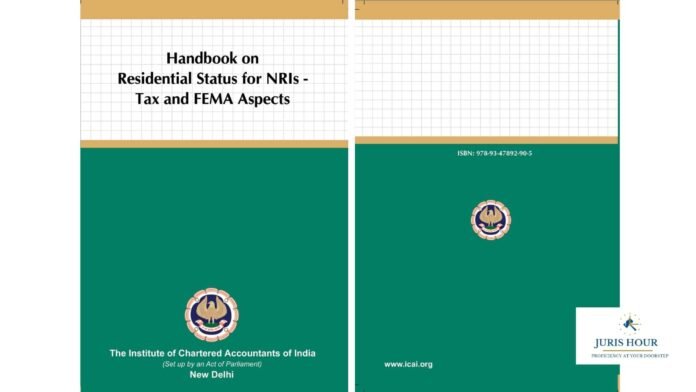
The crucial clarification forms part of ICAI’s newly released Handbook on Residential Status for NRIs – Tax and FEMA Aspects, published by its International Taxation Committee in July 2026. The handbook explains the residential-status provisions under the Income-tax Act, 2025, alongside the fundamentally different residence test prescribed under the Foreign Exchange Management Act, 1999.
Buy Now: E-Way Bill Judgements From 2020–2026 [Includes Orders of GSTAT]
According to the handbook, Section 6(7) of the Income-tax Act, 2025 operates as an independent deeming provision designed to prevent Indian citizens from becoming “stateless” for tax purposes while continuing to earn substantial income from India.
Under the provision, an Indian citizen can be deemed resident in India where three conditions are cumulatively satisfied: the person is an Indian citizen; the person is not liable to tax in any other country or territory by reason of domicile, residence or any similar criterion; and the person’s total income, excluding income from foreign sources, exceeds ₹15 lakh during the relevant tax year.
The provision applies irrespective of the ordinary physical-presence tests governing residential status. Consequently, satisfying neither the 182-day test nor the alternative day-count test would, by itself, protect an individual from being treated as a resident if the conditions governing deemed residence are fulfilled.
UAE Resident Spending Only 40 Days in India May Still Be Deemed Resident
The handbook illustrates the provision through the example of an Indian citizen residing in the United Arab Emirates who earns ₹22 lakh from rental income and dividends in India and remains physically present in India for only 40 days during the tax year.
Ordinarily, a stay of 40 days would be insufficient to make the individual an Indian resident under the conventional day-count tests. However, ICAI explains that the individual may still be deemed resident under Section 6(7).
In the illustration, the person is an Indian citizen, earns Indian-source income exceeding ₹15 lakh and is not liable to personal income tax in the UAE by reason of residence or domicile. The physical presence of only 40 days becomes irrelevant because the deemed-residence provision does not contain any minimum day-count requirement.
The handbook states that Section 6(7) is not merely an extension of the ordinary residence tests. It creates a separate basis for determining residence and operates as a residual provision where an Indian citizen would otherwise qualify as a non-resident.
ICAI explains that the provision seeks to address arrangements under which Indian citizens reside in jurisdictions that do not impose tax on individuals on the basis of residence or domicile, potentially allowing them to remain outside the tax-residence framework of every country while earning substantial income from India.
“Not Liable to Tax” Does Not Mean Tax Was Not Actually Paid
The handbook also cautions against equating the expression “not liable to tax” with the absence of an actual tax payment.
The relevant inquiry is not whether the individual ultimately paid tax in the foreign jurisdiction. The question is whether the person is subject to tax under that country’s domestic law because of residence, domicile or another similar connecting factor.
Therefore, a person who is legally liable to tax in another country but pays no tax because of deductions, exemptions, losses or a nil taxable income may stand on a different footing from a person who is not liable to tax there at all.
The distinction could prove decisive for Indian citizens residing in low-tax or no-personal-income-tax jurisdictions.
Deemed Resident Will Be Treated as “Not Ordinarily Resident”
ICAI has clarified that deemed residence does not automatically expose the individual’s entire global income to tax in India.
An Indian citizen deemed resident under Section 6(7) is classified as a Resident but Not Ordinarily Resident, or NOR, under Section 6(13)(c). No additional conditions are required to secure this classification.
As a result, foreign income that does not have a connection with India generally remains outside the Indian tax net. However, foreign income derived from a business controlled in India or a profession set up in India may be included in the individual’s taxable income.
The handbook consequently emphasises that determining whether a person is “resident” is only the first stage of the exercise. It must be followed by a separate determination of whether the individual is ordinarily resident or not ordinarily resident, since that classification controls the ultimate scope of taxable income.
₹15 Lakh Threshold Based on Income Other Than Foreign-Source Income
The handbook explains that the ₹15 lakh threshold is not calculated by considering the individual’s entire worldwide income. The relevant amount is total income other than income from foreign sources.
Income generally counted towards the threshold includes salary received in India, rent from property situated in India, interest from Indian bank deposits other than eligible NRE deposit interest, dividends from Indian companies and capital gains arising from assets situated in India.
Income deemed to accrue or arise in India, including specified interest, royalties and fees for technical services, may also form part of the calculation.
Conversely, salary earned from employment outside India, rent from foreign property, interest on foreign bank deposits and gains from the transfer of foreign assets would ordinarily be excluded as foreign-source income.
ICAI illustrates the distinction by noting that a person earning ₹18 lakh as rent from Indian property and ₹2 crore as salary in the UAE crosses the statutory threshold because the Indian rental income alone exceeds ₹15 lakh.
However, a person earning ₹12 lakh as dividends from Indian companies and ₹50 lakh from employment in Singapore would remain below the threshold because the foreign salary is excluded from the computation.
The handbook nevertheless notes an unresolved interpretational question over whether the ₹15 lakh threshold refers only to taxable income computed after applying exemptions and reliefs or encompasses Indian-source income more broadly. It records that, in the absence of a specific CBDT clarification or direct judicial precedent, the issue may remain open to interpretation.
High-Income NRI Visitors May Face 120-Day Residence Test
The publication separately explains the modified residence rule applicable to visiting Indian citizens and Persons of Indian Origin whose income, other than income from foreign sources, exceeds ₹15 lakh.
Such individuals may become resident if they spend 120 days or more in India during the tax year and were present in India for at least 365 days in aggregate during the four preceding tax years.
The 120-day provision does not replace the requirement relating to presence during the preceding four years. Both conditions must be met.
The handbook gives the example of a Person of Indian Origin ordinarily residing outside India who visits India for 140 days. If the individual’s qualifying Indian income exceeds ₹15 lakh and the preceding four-year stay exceeds 365 days, the person may be treated as resident even though the stay in the relevant year is below 182 days.
ICAI stresses that the income position must be determined before selecting the applicable day-count threshold. Depending upon the individual’s citizenship, purpose of visit and Indian-source income, the operative threshold could be 60, 120 or 182 days.
Income-Tax and FEMA Residence May Be Completely Different
Another major clarification in the handbook is that residential status under the income-tax law cannot be used to determine residential status under FEMA.
The Income-tax Act principally applies an objective physical-presence test based on the number of days spent in India. FEMA, in contrast, focuses on the purpose of the person’s stay and whether the individual intends to remain in or outside India for an uncertain period.
Consequently, the same person may be resident under the Income-tax Act but a person resident outside India under FEMA during the same year.
ICAI gives the example of an Indian citizen who has been living and working in Singapore for several years and visits India for 130 days for family and exploratory business purposes. Where qualifying Indian income exceeds ₹15 lakh and the preceding four-year stay requirement is fulfilled, the person may become resident for income-tax purposes under the 120-day rule.
Nevertheless, if the visit is for a defined and limited purpose and does not reflect an intention to remain in India indefinitely, the individual may continue to be treated as a person resident outside India under FEMA.
The reverse situation is also possible. A person returning to India in February with the intention of settling permanently may immediately become resident under FEMA from the date of return. However, because the individual may not have completed the necessary number of days in India, that person could remain non-resident for income-tax purposes for the same year.
FEMA Status Can Change Immediately on Departure or Return
Unlike income-tax residence, which is ordinarily determined for an entire tax year, FEMA status may change as soon as the person’s purpose or intention changes.
An individual leaving India for employment, business or another purpose indicating an intention to remain abroad for an uncertain period may become a person resident outside India from the date of departure.
Similarly, an NRI returning to India for employment or permanent settlement may become a person resident in India under FEMA from the date of return. This can trigger immediate consequences relating to the redesignation of bank accounts, holding of foreign assets, repatriation rights and overseas remittances.
A temporary visit for a holiday, medical treatment or family function would not ordinarily alter the person’s FEMA status.
Foreign-Asset Disclosures Require Particular Attention
The handbook identifies foreign-asset reporting as a significant compliance concern for returning NRIs. A person becoming resident for income-tax purposes must examine the requirement to disclose foreign assets in Schedule FA of the income-tax return.
The disclosure obligation can extend to overseas bank accounts, properties, investments and other assets legitimately acquired while the person was a non-resident.
ICAI cautions that non-disclosure may have consequences under the Black Money (Undisclosed Foreign Income and Assets) and Imposition of Tax Act, 2015, apart from liabilities under the income-tax law.
The handbook therefore advises professionals to separately determine residence under the Income-tax Act and FEMA instead of treating the two classifications as interchangeable. It underscores that an incorrect determination can lead to unintended taxation, reassessment, interest, penalties, improper maintenance of bank accounts and violations of exchange-control requirements.
The publication covers the transition from the Income-tax Act, 1961 to the Income-tax Act, 2025, treaty tie-breaker rules, foreign tax credit, expatriate employment, transfer pricing, global residence rules, FEMA requirements and worked case studies for NRIs and returning Indians.
Membership Required to Access Handbook Details & Copy
To view the complete Handbook Details and Download Copy, you must have an active membership. Please subscribe to continue.
Read More: GSTAT Dismisses Department’s Appeal for Violating Rs. 20 Lakh Litigation Threshold

