
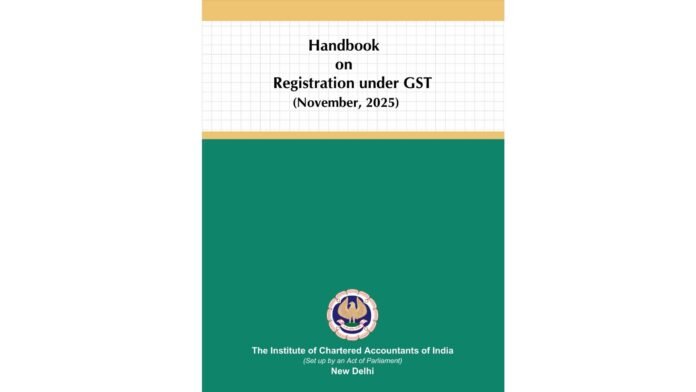
The Institute of Chartered Accountants of India (ICAI) has released the revised “Handbook on Registration under GST – November (3rd) 2025 Edition”, offering a comprehensive update on statutory amendments, threshold changes, and procedural reforms in the Goods and Services Tax (GST) framework up to 31 October 2025.
The latest edition, prepared by the GST & Indirect Taxes Committee, seeks to provide businesses, tax professionals and administrators with an authoritative reference guide at a time when GST continues to evolve through legislative and technological enhancements.
In the foreword, ICAI President CA Charanjot Singh Nanda highlighted that India’s GST regime completed eight years on 1 July 2025, marking a significant journey from its inception into a more transparent and tech-driven indirect tax system.
He credited the steady refinement of GST to the collaborative efforts of policymakers, administrators, tax authorities and professionals across the country. ICAI’s role, he emphasized, has been instrumental in providing technical insights, capacity-building initiatives and continuous support to strengthen the implementation of GST.
The revised handbook introduces detailed explanations of registration thresholds, providing clarity on distinctions between Special Category States and other States, the enhanced turnover limit of ₹40 lakh for exclusive suppliers of goods and the applicability of key notifications such as Notification No. 10/2019–Central Tax. It also elaborates how aggregate turnover must be computed on an all-India basis, encompassing taxable supplies, exempt supplies, exports and inter-State transactions while excluding inward supplies under reverse charge. The discussion includes judicial perspectives, notably the Gujarat Authority for Advance Ruling’s decision in Shree Sawai Manoharlal Rathi, which held that exempt interest income must still be factored into turnover for determining registration liability.
One of the most significant additions to the 2025 edition is the coverage of the newly introduced Simplified Registration Scheme, which streamlines procedural requirements and aims to ease compliance for small and medium enterprises. The handbook integrates screenshots, portal workflows and practical illustrations to help users navigate registration processes more efficiently using the GST common portal. Updates also cover Aadhaar authentication mandates, shift in verification procedures, and the expanding role of automated scrutiny in the approval or suspension of registrations.
The publication devotes extensive attention to compulsory registration scenarios under Section 24, explaining when businesses must register irrespective of turnover. These cases include inter-State suppliers, casual taxable persons, e-commerce operators, persons paying tax under reverse charge and suppliers of notified services such as app-based passenger transport. The 2025 legislative updates have widened the scope for mandatory registration, particularly in digital, e-commerce and service platform–based transactions.
The handbook further clarifies registration requirements for casual taxable persons and non-resident taxable persons, detailing the mandatory advance deposit of estimated tax liability, the 90-day registration validity and the extension procedure. It also outlines exceptions available to handicraft suppliers and artisans under specific notifications which exempt them from compulsory registration under certain conditions.
In addition to registration, the publication updates the sections on cancellation and revocation procedures, reflecting the compliance-focused amendments made from 2023 to 2025. These include provisions on suspension of registration, conditions for cancellation, timelines for application and the grounds on which authorities may revoke or refuse reinstatement. Real-world examples, case studies and portal screenshots have been incorporated to help users understand common errors and necessary documents for revocation.
In their preface, GST & Indirect Taxes Committee Chairman CA Rajendra Kumar P and Vice-Chairman CA Umesh Sharma described the handbook as a “living document,” continuously aligned with changes in GST law and emerging practical issues. They emphasized that the 2025 edition has been enriched with updated processes, screenshots and detailed illustrations to provide clarity to businesses and professionals facing increasingly system-driven GST compliance obligations.
With GST compliance becoming more automated and data-intensive, ICAI’s updated handbook is expected to serve as an essential resource for chartered accountants, businesses, tax administrators, startups, MSMEs and students. Priced at ₹200, the publication is available through ICAI’s official platforms and continues the organisation’s commitment to enhancing professional competence and supporting the nation’s tax ecosystem.

