
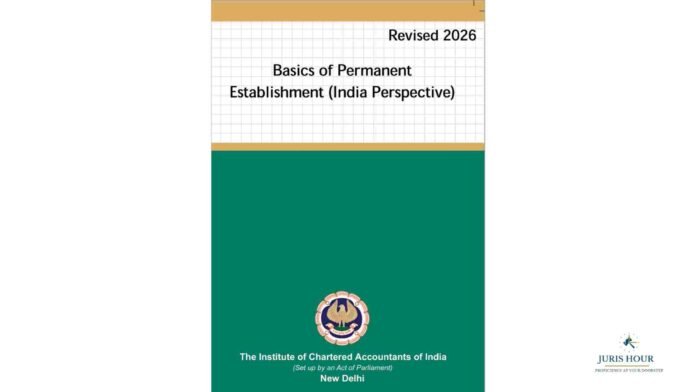
The Institute of Chartered Accountants of India (ICAI) has released the Second Edition (February 2026) of its publication titled “Basics of Permanent Establishment (India Perspective)”, brought out by the Committee on International Taxation. The updated edition comes at a time when the concept of Permanent Establishment (PE) continues to undergo significant transformation amid global tax reforms, digitalisation of economies, and increased scrutiny of cross-border business arrangements.
Table of Contents
PE Remains Central to Allocation of Taxing Rights
Permanent Establishment remains the cornerstone for determining when a foreign enterprise can be taxed in a source country in respect of its business profits. The publication reiterates that under tax treaties, business income of a foreign enterprise may be taxed in the source State only if the enterprise carries on business through a PE in that jurisdiction.
India, which follows a hybrid model of residence-based and source-based taxation, taxes non-residents on income that accrues, arises, or is deemed to accrue or arise in India under Section 5 read with Section 9 of the Income-tax Act, 1961. However, such taxation is subject to relief available under applicable Double Taxation Avoidance Agreements (DTAAs).
The ICAI publication explains that the concept of PE acts as the economic nexus threshold under Article 5 of tax treaties, largely modelled on the UN and OECD Model Conventions.
Focus on Significant Economic Presence (SEP)
The second edition places particular emphasis on India’s introduction and operationalisation of the concept of Significant Economic Presence (SEP) as a form of business connection. The SEP provisions, introduced pursuant to OECD BEPS Action Plan 1, represent a shift from physical presence-based nexus to economic engagement-based nexus.
With the Central Board of Direct Taxes (CBDT) having notified threshold limits for SEP, new interpretational challenges are expected, particularly regarding profit attribution and treaty interaction.
Judicial Developments: Substance Over Form
The publication also discusses recent landmark judicial pronouncements that have shaped India’s PE jurisprudence.
In the decision of Hyatt International Southwest Asia Ltd v CIT, the Supreme Court clarified aspects relating to fixed place PE and service PE, especially in scenarios involving brand usage, management services, and stewardship functions. The ruling reaffirmed that PE determination must be based on the nature, scope, and continuity of activities in India rather than mere commercial association.
Similarly, in Tiger Global International II Holdings v AAR, the Supreme Court underscored the importance of examining decision-making authority, control, and functional substance in offshore investment structures. The Court emphasised that treaty benefits operate within statutory boundaries and cannot protect impermissible arrangements.
The publication highlights that Indian courts have increasingly adopted a fact-intensive, substance-oriented approach while analysing fixed place PE, agency PE, and service PE.
Expanded Discussion on Types of PE
The book provides a structured analysis of various forms of PE under Article 5 of the UN Model Convention, including:
- Fixed Place PE
- Service PE
- Agency PE
- Construction and Installation PE
- Warehouse and Supervisory PE
- Emerging Virtual PE considerations
It also explores triangular PE situations, PE implications during the COVID-19 pandemic (including work-from-home scenarios), and recent OECD commentary updates on cross-border remote working arrangements.
Notably, India has expressed reservations regarding the OECD’s proposed time-threshold and “commercial reason” conditions for determining home-office PE, asserting a broader interpretation where activities carried out from home may still constitute a place at the disposal of the enterprise.
Policy Perspective: Reducing PE Litigation
The publication notes that PE disputes in India often take several years to reach finality, creating uncertainty for multinational enterprises. In this context, policy discussions—including those reflected in a NITI Aayog working paper—have recommended:
- Legislative clarity on PE and profit attribution
- Optional presumptive taxation safe harbours
- Strengthening of APA and MAP mechanisms
- Avoidance of retrospective amendments
- Alignment with BEPS Pillar One and Pillar Two reforms
Such measures aim to balance India’s source-based taxing rights with the need to provide certainty and reduce protracted litigation.
Practical Utility for Tax Professionals
The ICAI has clarified that the publication focuses primarily on foundational and conceptual aspects of PE, deliberately excluding detailed profit attribution methodologies, which warrant separate analysis.
The book is intended particularly for early-stage international tax practitioners, while also serving as a reference for seasoned professionals dealing with cross-border structuring, advisory, compliance, and litigation matters.
With increasing integration of global businesses and the digital transformation of commerce, the Second Edition seeks to equip professionals with a robust understanding of economic nexus principles that underpin international taxation in India.

