
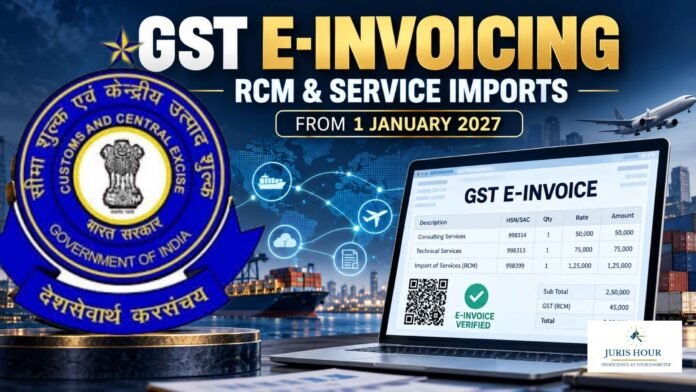
The Central Board of Indirect Taxes and Customs (CBIC) has expanded the scope of GST e-invoicing to include supplies received from unregistered persons on which the recipient pays tax under the reverse charge mechanism, as well as imports of services. The amendment will take effect from January 1, 2027.
The change has been introduced through Notification No. 04/2026–Central Tax, dated October 26, 2026, which amends Notification No. 13/2020–Central Tax, dated March 21, 2020.
The amendment brings specified inward transactions within the scope of the e-invoicing notification, alongside the existing coverage of supplies to registered persons and exports. Its application remains subject to the class of registered persons covered by the principal notification.
Buy Now: 160+ GST E-Magazine September 2026
What Has Changed?
The earlier wording of the principal notification referred to supplies of goods or services, or both, made to a registered person or for exports.
The latest notification replaces that wording with four expressly identified categories:
- Supplies of goods or services, or both, to a registered person.
- Supplies of goods or services, or both, for exports.
- Supplies of goods or services, or both, received from an unregistered person where the recipient is liable to pay tax under reverse charge.
- Imports of services.
The substantive expansion lies in the third and fourth categories. The notification now expressly covers specified inward supplies, extending the scope beyond the previously stated categories of outward B2B supplies and exports.
Reverse Charge Supplies From Unregistered Persons Included
The amendment specifically covers supplies received from an unregistered person where tax is payable by the recipient under the reverse charge mechanism.
Under reverse charge, the responsibility for paying GST rests with the recipient for transactions covered by the applicable legal provisions. The new wording brings such supplies from unregistered persons within the transaction scope of the e-invoicing notification.
Two conditions are central to this category: the supplier must be unregistered, and the recipient must be liable to pay tax on the supply under reverse charge.
Consequently, the amendment should not be read as extending e-invoicing to every purchase from an unregistered supplier. The reverse charge condition must also be satisfied, and the recipient must fall within the applicable class of registered persons.
Imports Of Services Added As A Separate Category
The notification separately includes imports of services within its scope.
This is a significant addition because the earlier wording addressed supplies to registered persons and exports without expressly identifying service imports as a separate transaction category.
For covered businesses, the change means that service import documentation will need to be assessed as part of their e-invoicing compliance preparations. Whether a particular transaction qualifies as an import of services, and its GST treatment, will continue to depend on the applicable statutory provisions.
The amendment expressly refers to imports of services; it does not add imports of goods as a separate category.
B2B Supplies And Exports Remain Covered
The existing coverage of supplies to registered persons and supplies for exports has been retained.
The amendment therefore expands the list of covered transactions while continuing the existing treatment of these two categories. From January 1, 2027, the notification will expressly identify both the retained outward supply categories and the newly added inward supply categories.
No Turnover Threshold Change In This Notification
Notification No. 04/2026–Central Tax changes the transaction categories specified in the principal notification. It does not amend the turnover threshold or the existing exclusions.
By way of background, Notification No. 10/2023–Central Tax introduced the ₹5 crore e-invoicing threshold with effect from August 1, 2023. The GST Council’s published material records that rollout for B2B transactions and exports.
Businesses must therefore examine the newly added transactions together with the eligibility conditions and exclusions under the principal notification, as amended. The latest change does not independently impose e-invoicing on every registered person receiving reverse charge supplies or importing services.
The notification has been issued under Rule 48(4) of the Central Goods and Services Tax Rules, 2017, on the recommendations of the GST Council.
Its operative amendment concerns the transactions covered by the e-invoicing notification. It does not itself prescribe a new GST rate, create a fresh reverse charge levy, or specify a new input tax credit entitlement.
For supplies received from unregistered persons, the notification expressly relies on an existing reverse charge liability. Businesses must first establish whether tax is payable by the recipient under the applicable provisions and then assess the associated invoicing requirements.
The expansion will require covered businesses to review inward supply documentation as part of their e-invoicing processes.
Preparations may include identifying transactions with unregistered suppliers that attract reverse charge, reviewing service imports, and assessing whether accounting systems can distinguish these transactions from ordinary purchases and outward supplies.
Businesses will also need to examine the applicable invoice reporting requirements and technical specifications when implementing the change. Notification No. 04/2026 itself sets out the expanded transaction scope and commencement date; it does not provide a detailed operational workflow.
The notification expressly states that it will come into force on January 1, 2027.
Membership Required to Access Notification Details & Copy
To view the complete Notification Details and Download Copy, you must have an active membership. Please subscribe to continue.

